
Wenger Law Rejected: Would It Have Given Attackers Too Much of an Edge?
At IFAB’s annual general meeting in London, Arsène Wenger’s much-discussed offside proposal was officially rejected, meaning it will not be added to the Laws of the Game at least for now. While the decision closes the door on immediate implementation, it does not end the debate around one of football’s most controversial rules.
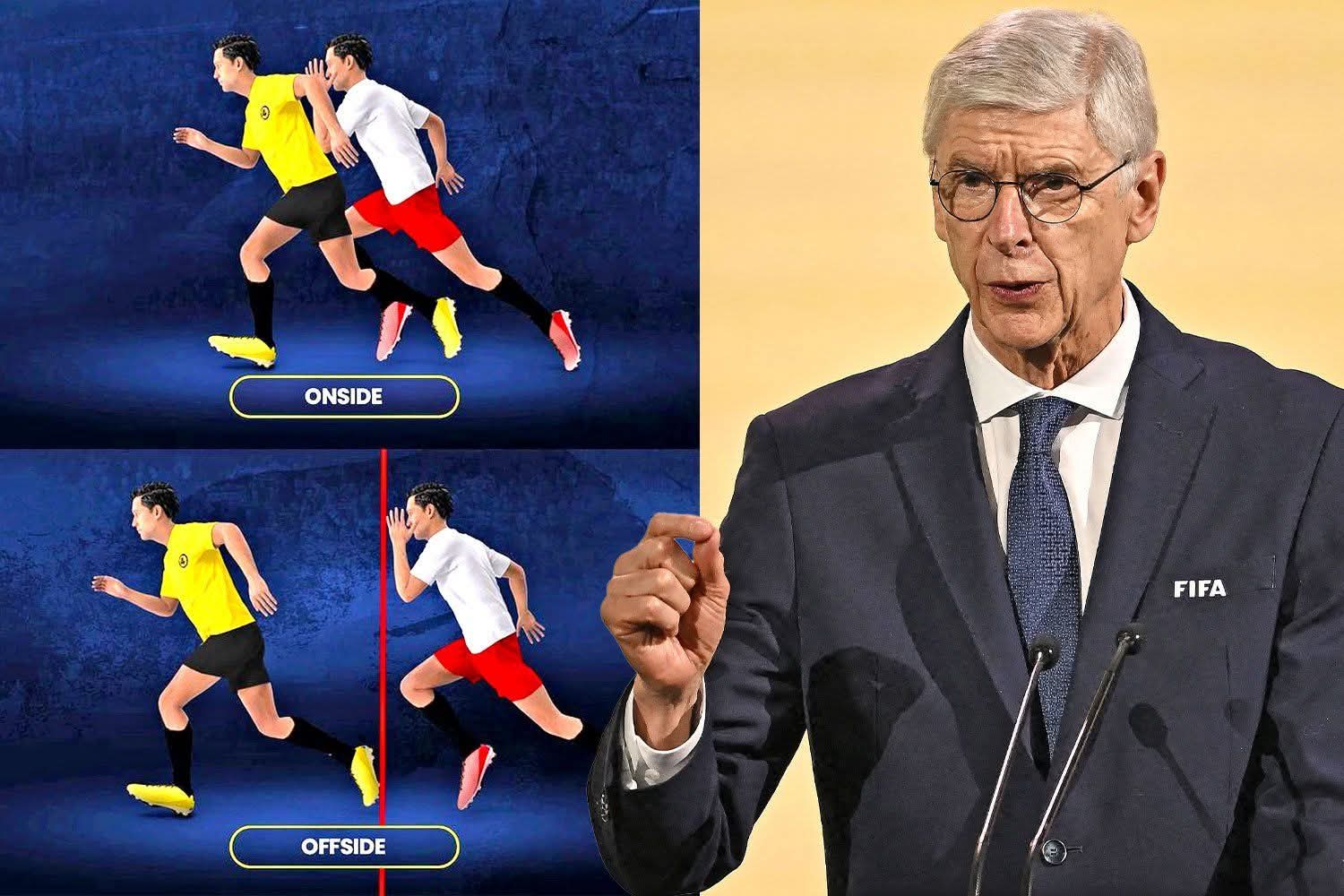
Wenger, FIFA’s Chief of Global Football Development, had proposed a significant reinterpretation of offside: an attacker would only be penalised if their entire body was beyond the last defender at the moment the pass was played.
In other words, if any part of the attacker’s body was still in line with, or behind, the defender, the goal would stand. The intention was simple—to eliminate marginal offside calls where goals are disallowed because of a toe, shoulder, or armpit detected by VAR.

For many fans and coaches, the proposal struck a chord. Modern football has seen an increasing number of goals ruled out after lengthy VAR checks, often for fractions of a centimetre. Wenger’s law aimed to restore the attacking spirit of the game, encourage forward play, and reduce controversies that leave supporters frustrated and confused.
However, IFAB ultimately decided that the proposal, in its current form, tilted the balance too far in favour of attackers. Critics argue that requiring an attacker’s entire body to be beyond the last defender would make defending significantly harder.
High defensive lines like Barcelona’s—already risky in the era of quick forwards—could become almost unmanageable, with attackers gaining a clear positional advantage even when appearing level with defenders.

There were also concerns about the tactical consequences. Defenders would be forced to drop deeper to compensate, potentially stretching teams vertically and altering the rhythm and structure of matches. Some stakeholders fear this could lead to more long-ball football and fewer compact, tactical battles in midfield.
Despite the rejection, the proposal is far from dead. IFAB has agreed that further trials can continue at lower-level competitions, allowing football authorities to collect more data on its real-world impact.
FIFA remains supportive of Wenger’s idea, believing it aligns with football’s long-standing principle of favouring attacking play. The challenge now lies in convincing more cautious European stakeholders, who prioritise maintaining competitive balance and defensive integrity.
In many ways, the rejection reflects football’s ongoing struggle to adapt tradition to technology. VAR has exposed the limitations of the current offside law, but changing it fundamentally is a step IFAB is not yet ready to take.
For now, the status quo remains. Marginal offsides will still be debated, lines will still be drawn, and frustrations will persist. But Wenger’s proposal has at least forced the game’s lawmakers to confront an uncomfortable question: should football continue to punish attackers for being millimetres ahead, or is it time to rethink offside in a way that better serves the spirit of the game?