
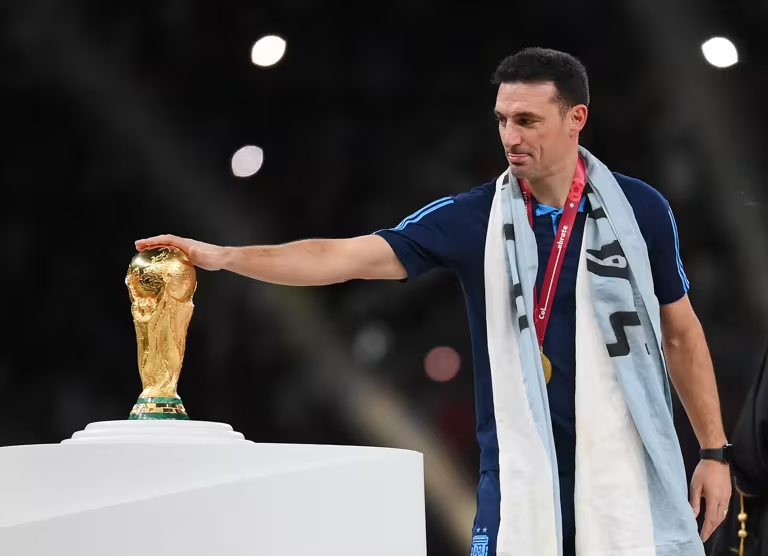
The FIFA World Cup 2026 in North America will feature a remarkable group of head coaches who already know what it takes to lead a team on football’s biggest stage.
Fourteen managers set to participate in the tournament have previously guided countries at the global finals, bringing a wealth of experience to their respective campaigns.
Among them are World Cup winners Didier Deschamps of France and Lionel Scaloni of Argentina, while seasoned campaigners like Mexico’s Javier Aguirre and Uruguay’s Marcelo Bielsa can trace their involvement all the way back to the 2002 tournament in South Korea and Japan.
The Three-Timers
Didier Deschamps (France) will lead his nation for a third consecutive World Cup. At 57, the former player and captain who lifted the trophy in 1998 added another winners’ medal from the dugout in Russia 2018 after France defeated Croatia in the final. Four years later in Qatar, his side came agonisingly close to repeating the feat, losing to Argentina in what many consider one of the greatest finals in tournament history. With Kylian Mbappe leading a gifted generation, Deschamps will fancy another deep run.
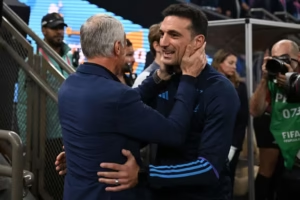
Marcelo Bielsa (Uruguay) will make history as the only coach in North America to have taken charge of three different countries at the World Cup. The Argentine, known affectionately as “El Loco,” first appeared in 2002 with his home country, though favourites Argentina crashed out in the group stage.
Eight years later, he guided Chile to the Round of 16, where Brazil ended their run. Now with Uruguay, Bielsa aims to restore pride after La Celeste’s disappointing group-stage exit in Qatar.
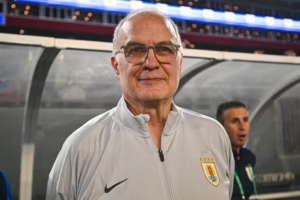
Herve Renard (Saudi Arabia) returns for his third World Cup after memorable campaigns with two different countries. At Russia 2018, he managed Morocco, who collected just one point in a tough group containing Portugal, Spain and Iran. Four years later, he pulled off one of the tournament’s greatest shocks as Saudi Arabia stunned eventual champions Argentina 2-1 in their opening match. After a spell with the France women’s team, Renard is back for another crack.

Javier Aguirre (Mexico) will experience his third World Cup, always at the helm of his home country. In 2002, Mexico impressed in the group stage only to be eliminated by rivals USA in the Round of 16. The story repeated in 2010. Strong group performances followed by a knockout defeat, this time to Argentina. Now facing a tournament on home soil, “El Vasco” faces his toughest test yet.
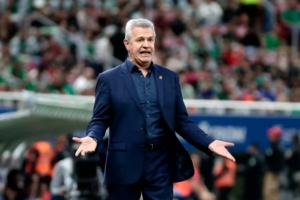
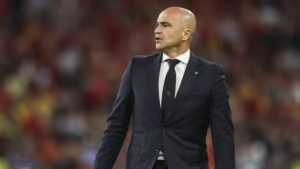
Roberto Martinez (Portugal) experienced highs and lows with Belgium before taking charge of Portugal. In 2018, he guided Belgium’s golden generation to third place, their best-ever finish. But 2022 brought disappointment as Belgium crashed out in the group stage. Now leading Portugal and fresh from winning the UEFA Nations League, Martinez will hope for better fortunes.
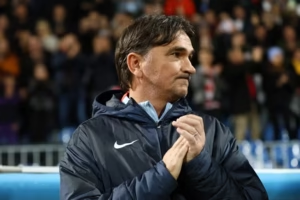
Zlatko Dalic (Croatia) transformed Croatian football during his tenure. In 2018, with Luka Modric at his brilliant best, Croatia reached the final before losing 4-2 to France. Four years later, with a slightly less powerful squad, they secured third place by beating Morocco after a semi-final loss to Argentina. Dalic’s first challenge in 2026 will be navigating a group containing England, Ghana and Panama.
Returning After Success
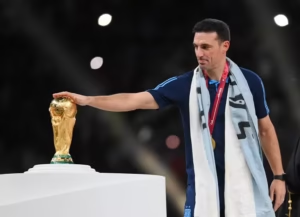
Lionel Scaloni (Argentina) experienced the World Cup as Jorge Sampaoli’s assistant in 2018 before taking the top job. In Qatar, he guided Argentina to glory, delivering the trophy many believed would be Lionel Messi’s last chance.
Now Scaloni has the opportunity to achieve something no Argentina coach has managed since the days of Carlos Bilardo and Luis Menotti: lifting back-to-back World Cups.
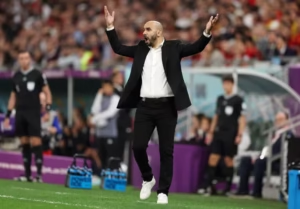
Walid Regragui (Morocco) masterminded one of the most remarkable campaigns in World Cup history. In Qatar, Morocco finished fourth, exceeding all expectations and capturing imaginations worldwide. That squad’s hunger remains, and Regragui stays at the helm hoping to replicate that historic run.
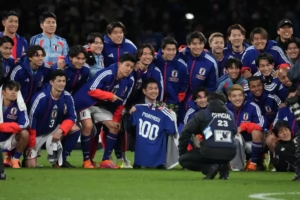
Hajime Moriyasu (Japan) saw his side’s Qatar dreams end in a penalty shootout defeat to Croatia after a hard-fought Round of 16 draw. Before that, Japan had finished top of a group containing Germany, Spain and Costa Rica. In 2026, Japan will be eager to go further.
Fresh Starts and Second Chances
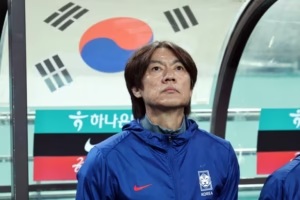
Hong Myungbo (Korea Republic) returns for his second World Cup as coach after a difficult debut in 2014. A legendary player and fan favourite, Hong’s first stint proved challenging as Korea finished bottom of their group. With a squad packed with talent, 2026 offers redemption.
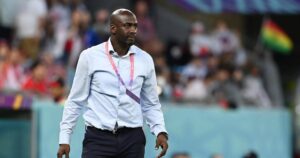
Otto Addo (Ghana) stepped down after Ghana’s disappointing 2022 campaign, where they finished bottom of their group. However, the former Borussia Dortmund player and coach returned in March 2024 and guided the Black Stars to qualification by October 2025.
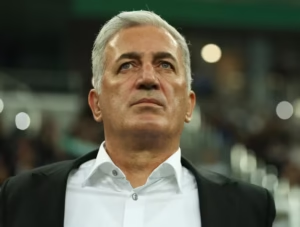
Vladimir Petkovic (Algeria) previously led Switzerland to the Round of 16 in 2018, where Sweden eliminated them. Appointed Algeria coach in February 2024, he brings tournament experience to a nation returning to the World Cup for the first time in 12 years.
Murat Yakin (Switzerland) took charge in 2021 and guided Switzerland through a tough group in Qatar, finishing behind Brazil. His side delivered one of the tournament’s most entertaining matches in a 3-2 victory over Serbia, though their campaign ended painfully with a 6-1 defeat to Portugal in the last 16.

Experience Not Everything
The article notes that previous experience does not guarantee success, nor does being a first-timer rule out a surprise. Scaloni’s triumph in Qatar despite no prior World Cup managerial experience proves that point perfectly. As the piece observes, making your World Cup debut is a completely different challenge to having a second or third attempt, and how coaches adapt their understanding and communication can make all the difference.
When the 2026 tournament kicks off across North America, these fourteen coaches will draw on their past experiences, good and bad, hoping that this time they can go all the way.