
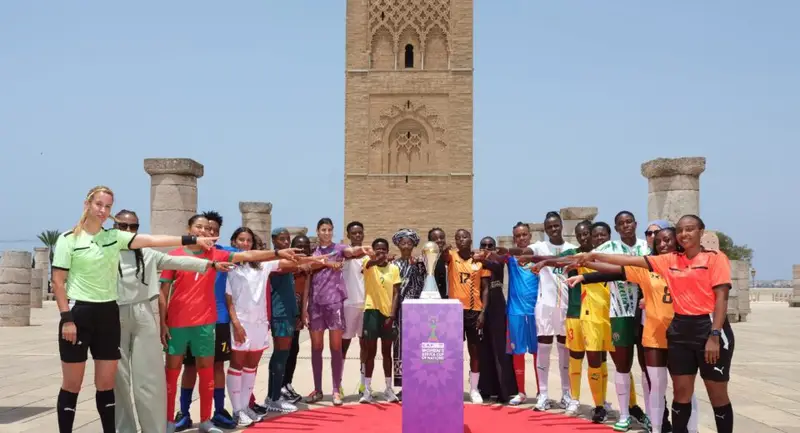
With less than two weeks until the scheduled kick-off of the Women’s Africa Cup of Nations (WAFCON) in Morocco, the Confederation of African Football (CAF) has still not confirmed whether the tournament will go ahead as planned.
The Current Uncertainty
The tournament is officially set to run from March 17 to April 3, 2026, with 16 teams preparing to compete for the continental title, which also serves as the qualification pathway for the 2027 Women’s World Cup in Brazil.
However, behind the scenes, reports have been swirling for weeks that the event might be postponed or moved.
CAF’s Head of TV and Commercial, Luxolo September, stated on March 3 that an announcement would be made within 48 hours, assuring that “the matter is receiving urgent and high-level attention.” Despite this promise, no official word has been released by CAF president Patrice Motsepe or the governing body .
The Shadow of the Men’s AFCON Final
The uncertainty surrounding the women’s tournament has led many to speculate about a connection to the recent men’s Africa Cup of Nations final, which took place in Morocco in January 2026. In that match, Senegal defeated the host nation Morocco 1-0 to claim their second AFCON Title.
The final was marred by controversy. Senegal took the lead, but when Morocco was awarded a penalty, Senegalese players protested strongly.
Coach Pape Bouna Thiaw was seen urging his players to leave the pitch, briefly throwing the final into chaos. It took Sadio Mané to calm his teammates and convince them to return.
Some players were also spotted entering the VAR area, leading to suspensions and fines, while fans threw objects onto the pitch.
In the buildup to that final, the Senegalese Football Federation had also accused Morocco of a lack of “fair play,” citing issues with security, hotel accommodations, and a very limited allocation of tickets for their supporters .
This tense backdrop has fueled whispers that Morocco’s willingness to host the women’s event may have cooled.
The sentiment on the ground in some circles is captured by a question making the rounds on social media by South Africa Sports Minister Gayton McKenzie “Are we now all being made to suffer because Senegal won the Men’s AFCON?
If Senegal had not won the final, would we still be sitting with this uncertainty? Morocco must accept that football is just a game where sometimes you win, sometimes you lose.” While this remains speculation, it reflects a growing belief that political frustration over the AFCON final might be playing a role in the women’s tournament crisis.
South Africa’s Offer
As doubts grew over Morocco’s ability to host, South Africa stepped into the spotlight. In early February, Deputy Minister of Sport, Peace Mabe, announced that South Africa would take over as host, claiming Morocco had indicated they were unable to stage the event.
However, her statement was quickly walked back. Sports Minister Gayton McKenzie clarified that no official decision had been made by CAF to move the tournament. He confirmed that Morocco was still the designated host but reiterated that South Africa was ready to step in if CAF required assistance.
This back-and-forth caused a single day of confusion where the host nation seemed to change, only to change back again.
Moroccan officials dismissed the episode as an “internal disturbance” within South African politics, insisting that any change of host would only be announced jointly by CAF and the FRMF.
What Happens Next?
The CAF Executive Committee was scheduled to meet on February 13 in Dar es Salaam, Tanzania, to discuss the tournament, but the lack of follow-up has deepened the uncertainty.
A press conference was expected after that meeting, but it has not yet materialized.
If the tournament is postponed, it creates a major problem for World Cup qualification. The 2027 Women’s World Cup is set for next year, leaving a narrow window to reschedule. Moving the WAFCON to later in 2026 could disrupt club seasons again, but canceling it would leave the continent without a clear way to determine its representatives for Brazil .
For now, teams like Ghana, Nigeria, and South Africa continue to prepare and play friendlies, acting as if the tournament is still on. South Africa has even unveiled a new kit for the competition.