What began as a hopeful preseason handball tournament aimed at uniting clubs and fostering sportsmanship has now become the center of an administrative disagreement, played out not in boardrooms or on the court, but through rival public notices.
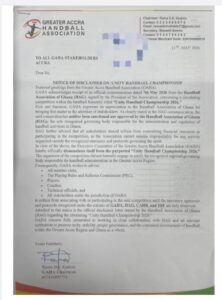
On the morning of 15th May 2026, the Greater Accra Handball Association (GAHA), acting on directives from the Handball Association of Ghana (HAG), issued a public disclaimer. The document sought to distance both governing bodies from the upcoming Unity Handball Championship 2026, scheduled for 20th–22nd May. Without explicitly naming fraud, the disclaimer implied irregularities in the tournament’s authorization, casting doubt on its legitimacy.
Hours later, the Organizing Committee of the tournament released its own press statement not to cancel the event, but to set the record straight.
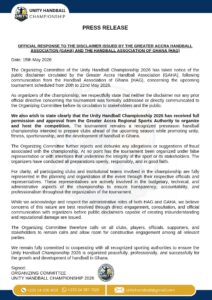
According to the Committee, the first sign of trouble came not through official correspondence, but through social media and stakeholder group chats. Neither Greater Accra Handball Association nor Handball Association of Ghana had directly communicated any concerns to the organizers before going public. The Committee stated, with visible frustration, that they had been left to learn of the governing bodies’ position through the same channels as the general public.
Yet the most striking revelation followed: the tournament had received full permission from the Greater Accra Regional Sports Authority, a recognized state sports regulator. In the organizers’ view, the championship was not rogue, unsanctioned, or fraudulent, it was lawfully approved, transparently budgeted, and actively co-managed with participating clubs.
The Committee further disclosed that representatives from each competing club were embedded in the tournament’s planning, finance, and technical operations. These representatives are actively involved in the budgetary, technical, and administrative aspects,”
the statement read. For the organizers, this was not a closed, secretive venture, but a collaborative effort built on shared decision-making.
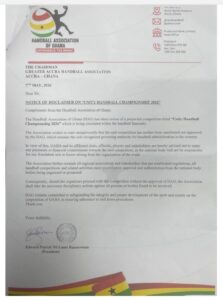
Behind all the legalities, some clubs wanted to prepare for the new season, so they took the initiative. They got approval from the Regional Sports Authority, contributed money, and started planning what they hoped would become a yearly preseason tournament. But somewhere along the way, communication between the organizers and the national handball federation broke down.
What remains unusual is the sequence. Typically, a national federation that questions a tournament’s status would first write a cautionary letter, call a meeting, or request documentation. In this case, the public disclaimer arrived first. The Organizing Committee’s response is polite but pointed:
Concerns of this nature are best resolved through direct engagement, consultation, and official communication with organizers before public disclaimers capable of creating misunderstanding and reputational damage are issued.”
As of today, the championship is still scheduled to proceed. The Organizing Committee has called for calm and constructive dialogue, while reaffirming its willingness to cooperate fully with both GAHA and HAG.