

The Confederation of African Football (CAF) has announced updated coaching requirements for all clubs and national teams participating in its competitions. This decision is aimed at raising the quality of coaching across the continent, with the goal of improving the structure, strength, and overall standard of play.
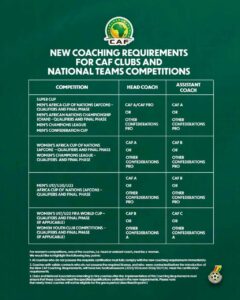
The new rules set specific license levels that head coaches and assistant coaches must hold to be eligible to take charge in CAF competitions. The requirements differ depending on the competition, with men’s and women’s tournaments having separate guidelines.
Requirements for Men’s Competitions
For major men’s tournaments such as the Africa Cup of Nations (AFCON), the African Nations Championship (CHAN), the CAF Champions League, and the CAF Confederation Cup, head coaches must hold a CAF A or CAF Pro license. They may also hold a Pro license from another confederation. Assistant coaches in these competitions must have a CAF A license or a Pro license from another confederation.
Requirements for Women’s Competitions
For the Women’s Africa Cup of Nations and the Women’s Champions League, head coaches must hold a CAF A license or a Pro license from another confederation. Assistant coaches in these competitions are required to have a CAF B license or a Pro license from another confederation.
For youth women’s competitions, including qualifiers for the FIFA U17 and U20 Women’s World Cups, head coaches must hold a CAF B license or an A license from another confederation. Assistant coaches in these youth women’s tournaments need a CAF C license or an A license from another confederation.
In a notable move to encourage greater involvement of women in coaching, CAF has also stated that for all women’s competitions, at least one of the coaches either the head coach or the assistant coach must be a woman.
Transition Period and Key Points
CAF has outlined important details regarding the implementation of these new rules:
1. Immediate Compliance: All coaches who do not currently hold the required certification must begin the process of meeting these new standards immediately.
2. Grace Period for Existing Contracts: Coaches who were hired before the new rules were introduced and have valid contracts that are still active will be given a grace period. They will have the next two football seasons (2025/2026 and 2026/2027) to obtain the necessary license.
3. No Grace Period for New Hires: Clubs and national associations that hire coaches after the announcement of these new requirements must ensure the coaches already meet the specified qualifications. Newly hired coaches will not be eligible for the two-season grace period.
With these changes, CAF aims to ensure that coaching standards across Africa continue to rise, leading to more competitive and well-structured football at all levels.