

When Tottenham Hotspur appointed Igor Tudor as interim head coach until the end of the season, the decision was framed as an emergency measure.
The club sought a manager known for fixing broken teams, a short-term stabilizer with no prior ties to the club, hired simply to steady the ship before a permanent replacement takes over in the summer.
Three matches into his tenure, that plan has unravelled. With three defeats, nine goals conceded, and a red card to show for his efforts, Tudor’s appointment is already being questioned. While a loss in the north London derby might have been forgiven, heavy defeats to Fulham and Crystal Palace have eroded any remaining faith in the new coach. It is a chaotic situation, but as many observers note, Tottenham have only themselves to blame.

A Worrying Slide Toward the Bottom
Before the match against Crystal Palace, results elsewhere had left Spurs just one point above the relegation zone. It should have served as a wake-up call. For a brief moment, it looked as though the message had been received when Dominic Solanke gave Tottenham the lead. However, that moment of hope lasted barely 60 seconds.
What followed was a complete collapse. In a chaotic seven-minute spell before half-time, Spurs conceded three goals, prompting large groups of supporters to head for the exits.
Some fans turned to direct their anger toward the director’s box, signaling that the atmosphere has become even more toxic than it was in the final days of Thomas Frank’s reign.
The statistics paint a grim picture. Tottenham are winless since December and have lost five consecutive top-flight matches for the first time since 2004.
They have conceded at least two goals in nine straight games. At home, they have collected just 10 points all season, the second-worst record across England’s top four divisions, ahead of only Sheffield Wednesday, a second-tier side already facing relegation.
As the home fans booed, Crystal Palace supporters taunted them with chants of “Say hello to Millwall,” a stark reminder of how close Spurs are to being dragged into a genuine relegation battle.
Tactical Gamble and Selection Surprises
Tudor was brought in to restore defensive discipline after the team lost its shape under Frank. Instead, the same problems have persisted. With no prior Premier League experience, the Croatian coach has stuck to a back-three system that has so far proven costly.
For the Crystal Palace match, Tudor made the bold decision to drop Xavi Simons and Conor Gallagher, two of Spurs’ most expensive recent signings. Top scorer Richarlison was also left on the bench. While the recruitment department may face scrutiny for assembling a squad that the head coach does not fully trust, Tudor’s choices raised eyebrows.
Nervousness was evident from the opening minutes. Nineteen-year-old Souza, making his Premier League debut after joining from Santos in January, was booked in the sixth minute for a reckless challenge.
Dominic Solanke was seen screaming at the referee in frustration, while Pedro Porro fumed over a free-kick decision. The score was still 0-0, but the tension was unmistakable.
Captain’s Error Proves Costly
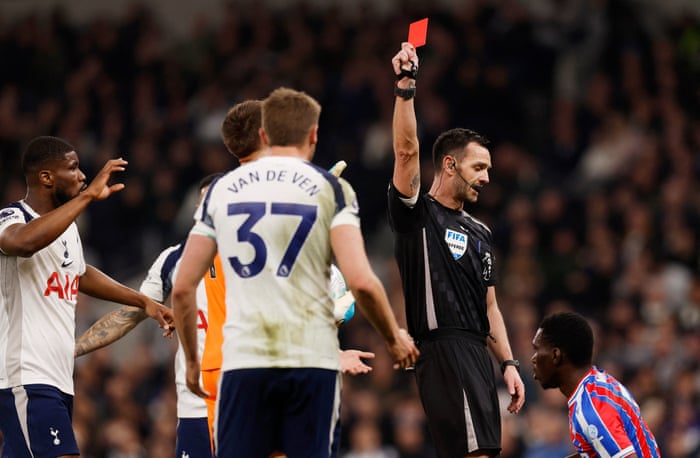
The game’s turning point came when Micky van de Ven, wearing the captain’s armband in Cristian Romero’s absence, pulled down Ismaila Sarr in the penalty area.
The resulting red card left Spurs with ten men and handed Palace a penalty. Van de Ven, celebrated last season for his heroics in the Europa League final, has seen his reputation suffer this term. Alongside Romero, whose four-match ban for a tackle on Casemiro has further weakened the squad, the senior players have set a poor example.
Tudor’s response to the red card was also questionable. He introduced Gallagher and Yves Bissouma at the expense of Souza and Randal Kolo Muani, leaving Spurs with five defenders and three midfielders on the pitch. Within five minutes, they had conceded twice. Mathys Tel, one of the few bright sparks this season, was pushed into an unfamiliar left wing-back role and made a sloppy pass that led directly to Palace’s third goal.
A Fight for Survival
In the second half, Spurs showed energy and desire but lacked quality. Solanke forced a save from Dean Henderson, and Archie Gray made some promising runs, but clear chances were scarce. Palace, meanwhile, wasted opportunities to make the scoreline even more embarrassing.
When Porro was substituted, he argued with the fourth official, smashed a water bottle, and punched a chair in frustration. By full-time, the boos echoed around a stadium that was mostly empty.
Sacking Tudor after just three games would be a harsh indictment of chief executive Vinai Venkatesham and sporting director Johan Lange. Yet, with each passing defeat, that option becomes more plausible. The problem is that trust in the club’s leadership is so low that many fans doubt they could appoint a suitable replacement anyway.
Next week’s Champions League tie against Atletico Madrid now feels like an unwelcome distraction. For Tottenham, the priority is clear, avoiding relegation. By the time they play at home again, they could find themselves in the bottom three. Perhaps that is the shock this squad needs.
After the match, Tudor insisted he still believed in his project. “I believe more after this game than I believed before,” he said. “I saw something. I need to choose the right guys because the boat is going in the direction I want. Who is in the boat can stay. Otherwise, they can leave the boat.”