

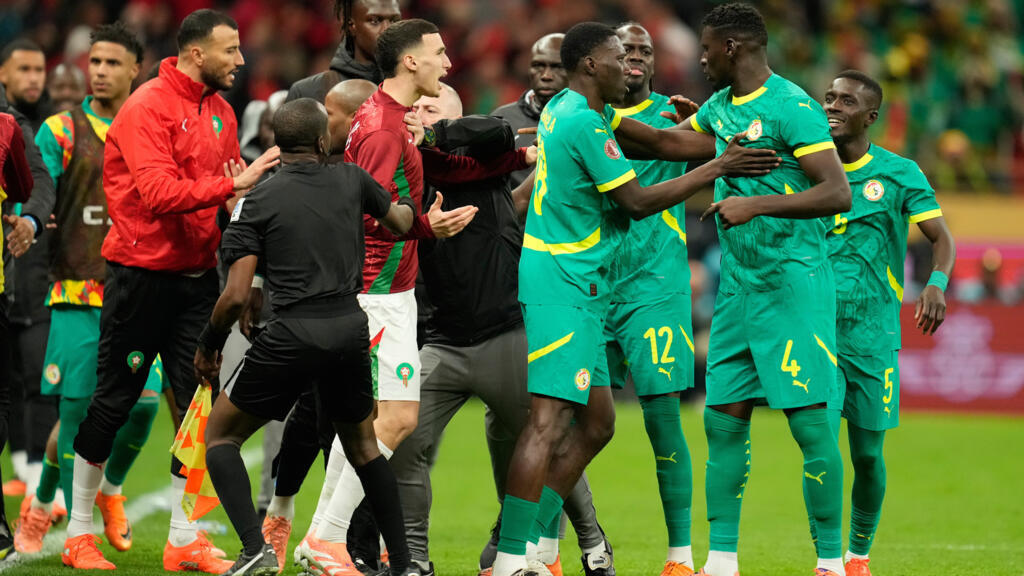
The 2025 Africa Cup of Nations final has been plunged into an unprecedented crisis following a major investigative report by French newspaper Le Monde, which alleges that Senegal players walked off the pitch in the 97th minute of the final and that match officials were instructed to withhold red cards to avoid a “live broadcast scandal.”
If confirmed, the revelations could lead to Senegal being forced to forfeit the AFCON title, with the trophy potentially reassigned to Morocco. The case is expected to be brought before the Court of Arbitration for Sport (CAS) in Lausanne, Switzerland.
The Alleged Incident
According to Le Monde’s investigation, the closing stages of the AFCON final descended into chaos when Senegalese players reportedly left the field of play without authorization in the 97th minute. Under the Confederation of African Football (CAF) regulations, specifically Article 78 of the CAF Disciplinary Code, such an act constitutes an abandonment of the match. The standard sanction is an automatic forfeit, awarding victory to the opposing team.
The report does not specify the immediate trigger for the alleged walkout, but sources close to the investigation suggest that disputes over earlier officiating decisions may have inflamed tensions on the pitch. However, CAF has not released any official match report detailing the incident, leaving a vacuum of transparency that the Le Monde investigation now seeks to fill.
Perhaps more damaging than the walkout itself are claims of direct interference with officiating protocol. The investigation alleges that senior officials present at the stadium, unnamed in the report instructed the match referee and his assistants not to issue red cards to Senegal players during the walkout. The purported reason to prevent a visibly chaotic mass ejection from being broadcast live to a global audience, thereby averting a “public relations catastrophe” for CAF and tournament sponsors.
If proven, such instructions would violate fundamental principles of match integrity and referee independence, potentially exposing CAF to claims of institutional manipulation.
Legal experts consulted by this publication note that CAF’s own disciplinary framework leaves little room for ambiguity. Rule 79 of the same code states that any team refusing to continue a match or leaving the pitch without a valid reason shall be declared the loser. Consequently, the original result of the final currently recorded as a victory for Senegal would be nullified.
However, it remains unclear whether the opposing finalists (whose identity Le Monde has withheld pending further corroboration) would be automatically awarded the trophy or if a replay could be ordered. In similar cases, such as walkouts in domestic leagues, the non-offending side is typically granted a 3–0 victory and the associated title.
CAS Appeal Likely
The investigation states that legal representatives from the aggrieved party have already begun preliminary preparations to file an appeal with the Court of Arbitration for Sport. Given the magnitude of the allegations including sporting fraud and breach of CAF’s own regulations CAS is expected to fast-track proceedings.
Any CAS ruling overturning the final result would mark the first time in AFCON history that a champion was stripped of a title post-match. It would also raise serious questions about match integrity across CAF’s flagship competition.
As of press time, CAF has not issued any official statement responding to the Le Monde investigation. Attempts to reach the Senegalese Football Federation were met with automated replies indicating that officials were “unavailable for comment.” Tournament stakeholders, including broadcast partners and title sponsors, are said to be “closely monitoring” the situation.
Beyond the fate of the 2025 title, the scandal threatens to undermine confidence in CAF’s governance. The alleged cover-up of red cards to protect broadcast optics suggests a prioritization of commercial interests over sporting fairness a charge that has dogged African football administration for decades.
Football governance watchdog groups have already called for an independent inquiry, separate from CAF’s internal disciplinary mechanisms, to examine whether senior officials attempted to influence match outcomes.
Next Steps
Within 48 hours: CAF is expected to release a formal response, though pressure is mounting from member associations for an immediate statement.
Within seven days: The aggrieved party is likely to submit an urgent application to CAS seeking interim measures, including the suspension of Senegal’s title celebration.
Within 30 days: If the CAS proceedings commence, a preliminary hearing could determine whether the match result is provisionally voided pending a full ruling.