

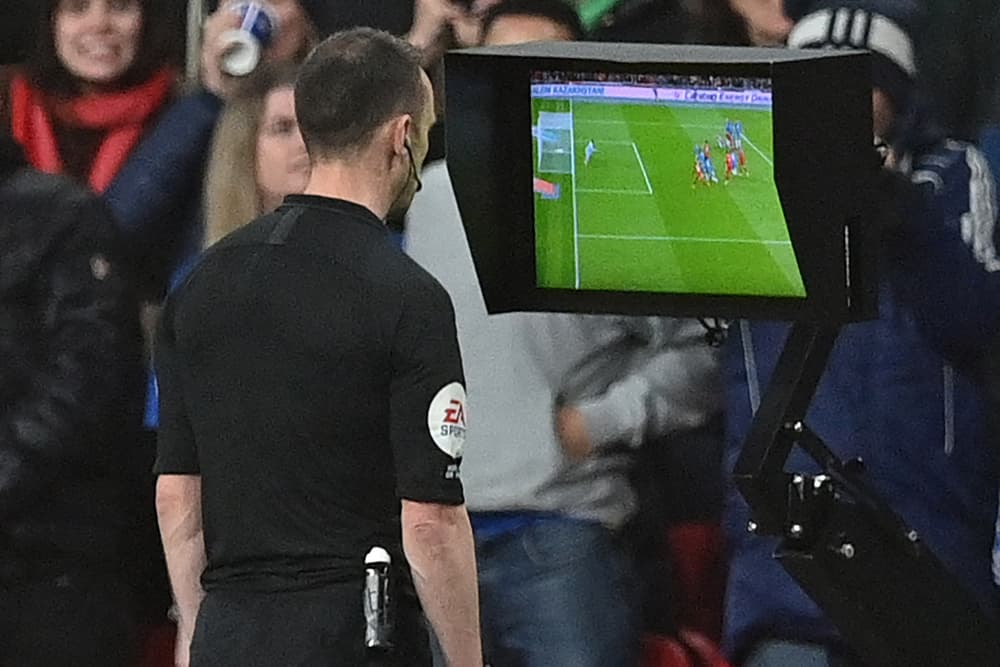
Video assistant referees will be able to check corners and second yellow card decisions at this summer’s World Cup after football’s law-makers approved rule changes.
The International Football Association Board (IFAB) met in Wales on Saturday and agreed to expand VAR’s role at the tournament.
New measures to stop time-wasting will also be introduced from June 1, including countdowns for goal-kicks, throw-ins and substitutions.
The changes will apply for the 2026-27 season.
What VAR can now check
World governing body Fifa pushed strongly for VAR to review corners at the World Cup, arguing it would help fix clear mistakes.
Leagues can choose whether to adopt this change. The Premier League is not expected to, and Uefa is also believed to be against it. Italy’s Serie A will likely use it.
VAR will also now be able to look at incorrectly awarded second yellow cards that lead to a player being sent off.
This follows incidents where players have been wrongly dismissed for a second booking. In one recent case, Juventus defender Pierre Kalulu was sent off after minimal contact, and the referee admitted VAR could not correct the error.
The Premier League’s Key Match Incidents Panel found 17 players were wrongly sent off for two cautions in the past two seasons.
VAR can also step in if a yellow card is given to the wrong player, for example, if a player is booked for handball but the ball actually hit an opponent’s arm.
New time-wasting rules
A series of measures to speed up play have been approved:
Goal-kicks and throw-ins : Players will face a countdown. If they take too long, possession switches to the opposition. A goal-kick could become a corner, or a throw-in would go to the other team.

Substitutions : A substituted player must leave the field within 10 seconds. If they do not, their replacement cannot come on immediately. The team must play with one fewer player for at least 60 seconds or until the ball next goes out.
Injured players : Players who go off for treatment must stay off for one minute – double the current 30-second rule in the Premier League. Exceptions include if an opposition player is booked or sent off, if a substitution is being made, or if the player is needed to take a penalty. Goalkeepers are also exempt.
Ifab did not agree a solution for so-called ‘tactical timeouts’ when goalkeepers receive treatment to slow the game down. Further trials will be held to find ways to stop this.
Other changes
Denying a goalscoring opportunity : The law now covers situations where the player fouled could have passed to a team-mate with a better scoring chance. This is expected to apply to fast counter-attacks.
Advantage played : If a player commits an offence that would normally be a sending-off but advantage is played and a goal is scored, they will not receive a yellow card.
Talking to the referee : Guidelines about only the captain being able to speak to the referee have been added to the laws.
Jewellery : Players can now tape over jewellery if it cannot be removed.
Wenger’s offside idea to be trialled
Former Arsenal manager Arsene Wenger’s proposal to change the offside law will finally be tested.
The Canadian Premier League will trial the rule when its new season begins in April.
Wenger, who is Fifa’s head of global football development, wants a complete gap between the attacker and the last defender. This is sometimes called ‘daylight offside’.
Critics say this would give too much advantage to attacking teams.
Results of the trial will be presented to IFAB at the end of the year. The law could change across the world for the 2027-28 European season, though more trials may be needed first.