

In a move set to reshape African football, the Confederation of African Football (CAF) has announced a sweeping overhaul of its international calendar. Effective from 2027, the governing body will introduce the African Nations League, a multi-tiered competition structure that will replace the African Nations Championship (CHAN) and fundamentally alter the scheduling of the Africa Cup of Nations (AFCON).
The ambitious proposal, detailed in official documentation, signals a strategic shift aimed at maximizing the continent’s competitive potential, increasing commercial viability, and providing a consistent annual rhythm of high-stakes international football.
A New Hierarchy: The African Nations League
The centerpiece of the reform is the establishment of the African Nations League, a two-pronged competition designed to bridge the gap between regional qualifiers and the flagship AFCON tournament.
1. African Nations League – Continental
This annual competition will serve as the primary qualifying and competitive pathway for the majority of CAF’s member associations. The format begins with regional zone play, allowing for reduced travel and intensified local rivalries. Following the regional phase, the best-performing teams will advance to a final tournament hosted in a single country.
In a departure from the now-defunct CHAN, the Continental tier will be open to all players, including Europe-based stars. This ensures that the competition will feature the continent’s strongest available squads on an annual basis, dramatically increasing its appeal and competitive intensity.
2. African Nations League – Pan-African
Scheduled to take place every two years, this elite competition adopts the format of the traditional Africa Cup of Nations, featuring 24 national teams. This tier serves as the premier tournament during the non-AFCON years, providing a high-profile African championship that maintains the excitement of a major finals while preserving the prestige of the newly restructured AFCON.
AFCON Elevated: A Quadrennial Spectacle
Under the new structure, the Africa Cup of Nations (AFCON) will transition to a four-year cycle. The document outlines the proposed schedule, with AFCON editions slated for 2027, 2030, and 2032.
By increasing the gap between tournaments, AFCON will become Africa’s elite, flagship competition. The move is intended to enhance its prestige, increase its commercial value, and allow for more robust qualification processes, ensuring that when the tournament does take place, it represents the pinnacle of African football.
Proposed Schedule Overview
According to the documentation, the transitional calendar will begin in 2027:
· 2027: Africa Cup of Nations (28 teams)
· 2028: Africa Nations League – Continental (Regional champions, finals in November)
· 2029: Africa Nations League – Continental (Finals in November) / Africa Nations League – Pan-African (24 elite national teams)
· 2030: Africa Cup of Nations (28 teams)
· 2031: Africa Nations League – Continental (Regional champions, finals in November)
· 2032: Africa Cup of Nations (28 teams)
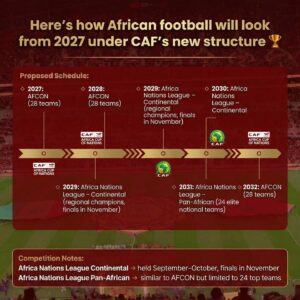
Competition Notes
The document clarifies the operational rhythm of the new leagues:
· Africa Nations League (Continental): Held primarily from September to October, with the finals culminating in November.
· Africa Nations League (Pan-African): Structured similarly to the traditional AFCON but limited to the continent’s 24 top-tier national teams, ensuring a high standard of competition in even-numbered years between AFCON cycles.
This structural overhaul represents one of the most changes to African football in decades. By creating a continuous cycle of competition from regional qualifiers to the elite Pan-African tournament, culminating in a prestigious, quadrennial AFCON, CAF aims to align African football more closely with the long-term development cycles seen in other global football powerhouses.
The new framework is set to commence in 2027, pending final ratification by the CAF executive committee.