
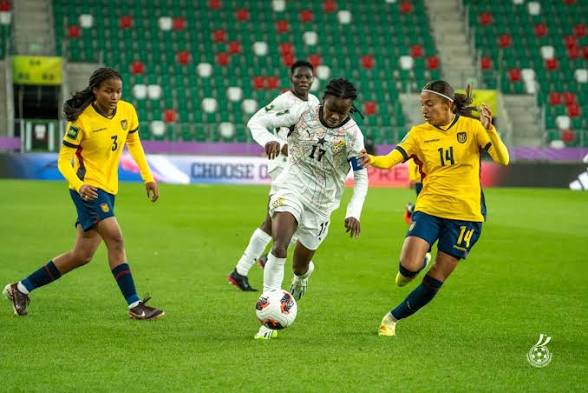
Black Princesses’ Defeat to Ecuador Exposes Familiar Problems as Knockout Dream Hangs in Balance
The Black Princesses could hardly have imagined a more difficult start to their 2026 FIFA U-20 Women’s World Cup campaign. A 3-0 defeat to Ecuador has not only left Ghana without a point after the opening round of matches, but has also exposed some of the weaknesses that could once again prevent the team from advancing beyond the group stage.
The biggest problem was Ghana’s start. Conceding twice within the opening 17 minutes meant the Black Princesses were forced to chase the game almost immediately. Rosa Flores struck in the fourth minute before Domenica Arboleda doubled Ecuador’s advantage, leaving Ghana with a mountain to climb before they had properly established themselves.
Charles Sampson’s assessment that the goals were “cheap” is particularly significant. At this level, early defensive errors can have consequences beyond the goals themselves. They can alter the psychological balance of a game, give the opposition confidence and force the team trailing to abandon parts of its original game plan.
That appeared to happen against Ecuador. Ghana were unable to find the response required after going behind, and although opportunities came in the final third, the Black Princesses lacked the clinical finishing needed to turn promising situations into goals.
Sampson acknowledged that weakness, admitting that Ghana were “not clinical enough in the last third” and should have scored to get themselves back into the contest.
That is where the defeat becomes more concerning than the scoreline alone. Ecuador did not simply punish Ghana with three goals.
They also demonstrated the value of taking their chances when they arrived. Once Ghana failed to reduce the deficit, Ecuador became increasingly comfortable defending their advantage and eventually exploited the spaces Ghana left behind.
Arboleda’s second goal in the 70th minute effectively ended any realistic prospect of a comeback.
Yet there were positives for Sampson to take from the performance. His praise for the players’ “attitude and character” suggests that the team did not completely lose its competitive edge despite the difficult circumstances. That response could prove important because Ghana’s tournament is far from over.
The challenge, however, is that the remaining fixtures offer little room for another slow start.
Ghana face South Korea on Wednesday, September 9, before meeting France three days later. South Korea and France shared a 1-1 draw in the other opening Group C fixture, meaning Ghana are already behind both remaining opponents.
That makes the South Korea game particularly important. Another defeat would leave Ghana facing an almost impossible task in their final group match. A victory, on the other hand, would immediately change the equation and give the Black Princesses something tangible to build on before the France encounter.
The tactical lesson from Ecuador is therefore clear. Ghana cannot afford another opening period dominated by defensive uncertainty.
They must also improve their efficiency in front of goal because creating chances without converting them will not be enough against stronger opposition.
There is also a larger historical issue at stake.
The Black Princesses are appearing at the U-20 Women’s World Cup for the eighth consecutive time, underlining Ghana’s consistency in qualifying for the competition. But that consistency has not translated into progression. Ghana are still searching for their first appearance in the knockout stage.
That makes this campaign about more than simply recovering from one defeat. The Black Princesses have repeatedly reached this stage without taking the next step, and the Ecuador result has made that familiar problem even more difficult to overcome.
Sampson is right to insist that his players redirect their energy towards the remaining games. But recovery cannot mean simply putting the defeat behind them. Ghana must learn from precisely what went wrong.
The early defensive lapses have to be eliminated, the attacking opportunities must be converted and the team’s response after conceding must improve. Otherwise, the Black Princesses risk another group-stage exit and another missed opportunity to turn their remarkable qualification record into meaningful progress on the world stage.