

Tadej Pogacar claimed his first victory in Milano-Sanremo on Saturday, beating Tom Pidcock in a two-up sprint decided by a photo finish after a race marked by crashes, aggressive racing and high tension across the final climbs.
The 2026 edition of cycling’s longest Monument followed its usual pattern for much of the day. A large breakaway group went up the road and built a comfortable lead, while the main peloton stayed calm behind.
Alpecin-Premier Tech controlled the pace through the early kilometres, with Silvan Dillier doing much of the work at the front.
The rhythm began to change when UAE Team Emirates moved forward. Domen Novak raised the speed and started to bring the breakaway’s advantage down. That shift marked the moment when the race moved from a period of control to the more intense phase that would decide the outcome, as the riders approached the Ligurian coast and the key climbs that followed.
Positioning Becomes Crucial
As the race reached the Cipressa, the fight for good positioning became the main focus. Teams pushed to place their leaders at the front before the first truly decisive point of the day. The tension inside the peloton rose sharply, and it was during this battle for position that the race took a dramatic turn.
Pogacar crashed heavily on the run-in to the climb. Wout van Aert, Biniam Girmay and Matteo Jorgenson went down with him. The crash split the peloton and put several of the main contenders in serious trouble at the worst possible moment.
All the riders were able to get back on their bikes, but the effects of the crash were clear. Van Aert needed a bike change and lost ground, while Pogacar was visibly affected by the fall. He had to chase hard just to rejoin the main group before the climb he had planned to attack.
The Cipressa and the Poggio
Despite Pogacar’s efforts, the Cipressa did not create the big gaps that many had expected. He reached the top first, but both Pidcock and Mathieu van der Poel stayed close enough to keep the race finely balanced as the riders headed down the descent.
Behind them, however, the damage from earlier in the day had taken its toll. The peloton had been reduced and stretched, and several riders were already at their limit as the race moved towards the Poggio, the final climb.
On the Poggio, Pogacar made his move count. He attacked repeatedly, and this time the pressure proved too much for Van der Poel. The Dutch rider lost contact and could not return before the summit. Pidcock, however, held on. He stayed with Pogacar, turning the race into a two-man battle at the front.
That moment reshaped the final part of Milano-Sanremo. Van der Poel was left chasing and was soon caught by a group that included Van Aert, who had fought his way back into contention after the earlier crash. The victory would now be decided between the two riders ahead, but the outcome remained uncertain.
Over the top of the Poggio, Pogacar and Pidcock committed fully to their move. There were brief moments of hesitation, but the pair worked together on the descent and into the final kilometres. Both knew that any loss of speed would allow the chasing group to catch them.
Pidcock was not happy to simply follow. He pushed the pace on the descent, keeping the pressure on and ensuring the effort stayed high. Pogacar responded each time, matching the speed as the two riders drove towards Sanremo.
Behind them, the chase continued. Van der Poel had been brought back, and Van Aert launched a late attack in a final attempt to bridge across to the leaders. The move briefly raised the tension once more, but the gap proved too large to close.
With one kilometre to go, the dynamic between the two leaders changed. With victory within reach, Pidcock refused to take turns at the front. Pogacar was forced to take control as they approached the Via Roma. The cooperation that had kept them clear gave way to a tactical standoff, with both riders knowing the Monument would be decided in a sprint.
Pogacar launched his sprint early, committing from the front and forcing Pidcock to respond. The British rider came alongside in the closing metres, and the two were almost inseparable as they surged towards the line.
A photo finish was needed to separate them. When the result came, it showed that Pogacar had done just enough.
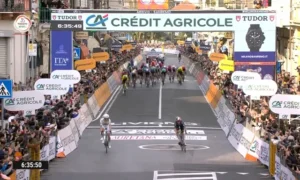
After hours of attacking racing and close calls in Milano-Sanremo, the Slovenian finally took victory in cycling’s longest Monument. For Pidcock, it was a second-place finish that showed his strength, while Van der Poel and Van Aert were left to reflect on what might have been after a day shaped by crashes and fine margins.