
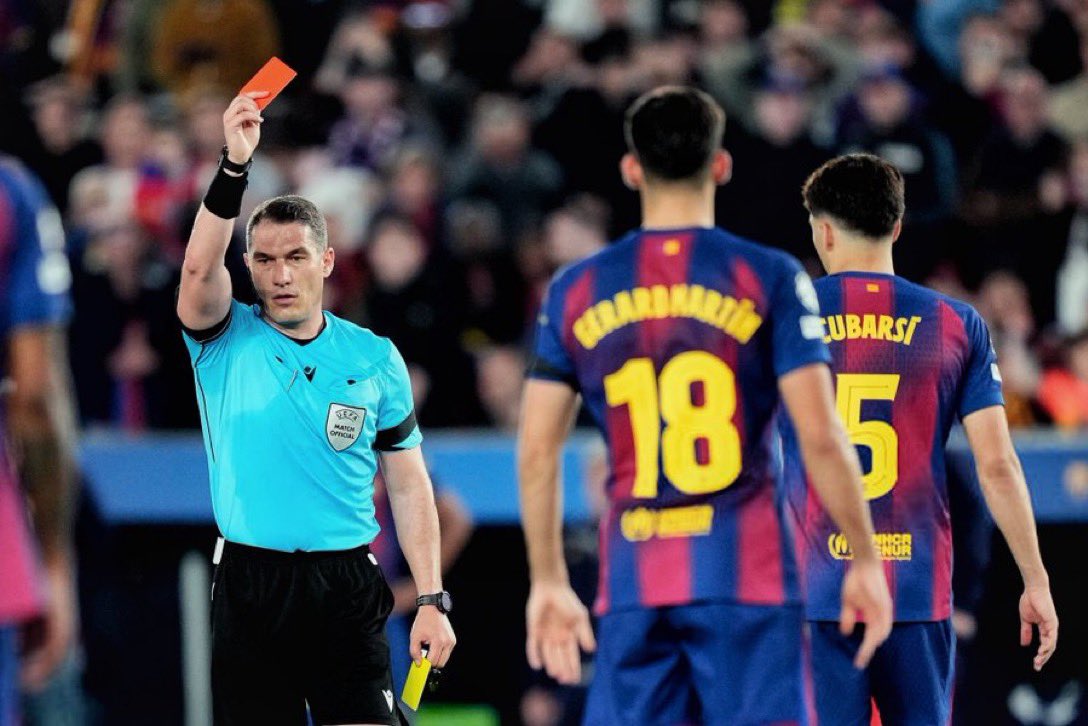
Barcelona Lodge Official Complaint to UEFA Over Officiating
FC Barcelona have officially lodged a complaint with UEFA following a series of contentious refereeing decisions during their UEFA Champions League quarter-final clash against Atlético Madrid.
The Catalan giants were eliminated 3-2 on aggregate despite a spirited 2-1 victory in the second leg at the Wanda Metropolitano.
However, the fallout from the tie has now shifted focus from the pitch to officiating standards, with Barcelona questioning the consistency and application of decisions across both legs.
In an official statement released by the club, Barcelona did not hold back in expressing their dissatisfaction with the handling of key moments during the tie.
“FC Barcelona have submitted a complaint to UEFA regarding the refereeing performance in the Champions League quarter-final tie played against Atlético Madrid.”
According to FC Barcelona, the accumulation of these errors had a direct impact on the course of the matches and on the final outcome of the tie, causing significant sporting and financial harm to the club.
Through this complaint, the Club reiterates the requests previously made to UEFA and, at the same time, offers to collaborate with the football governing organisation in Europe with the aim of improving the refereeing system to “ensure a more rigorous, fair and transparent application of the Laws of the Game.”
Flashpoints Across Both Legs
Barcelona’s frustration is rooted in several pivotal incidents that shaped the trajectory of the tie against Atletico Madrid.
Chief among them were the red card decisions issued in both legs, moments the club believes were either harsh or incorrectly adjudicated.
“The club considers that, across both legs of the tie, several refereeing decisions were made that did not comply with the Laws of the Game, resulting from an incorrect application of the regulations and a lack of appropriate intervention by the VAR system in incidents of clear significance.”
In the first leg, young defender Pau Cubarsí was sent off in a decision that immediately tilted the balance in Atlético’s favour. Reduced to ten men, Barcelona struggled to maintain their structure, ultimately conceding ground in a match that set the tone for a difficult return leg.
The controversy intensified in the second leg when Eric García was also dismissed following a challenge on Norwegian striker, Alexander Sørloth. Initially shown a yellow card, the decision was upgraded to a red after VAR intervention, another moment Barcelona have strongly contested.
These decisions, coming at crucial junctures in both matches, significantly altered the tactical dynamics. Playing with ten men in each leg forced Barcelona into reactive football, limiting their ability to control proceedings and execute their attacking game plan and ultimately exiting the competition in the quarter finals.
Barcelona’s complaint goes beyond isolated incidents. The club argues that the cumulative effect of these decisions directly influenced the final outcome of the tie. Despite showing resilience, particularly in the second leg where goals from Lamine Yamal and Ferran Torres secured a win on the night, the damage done across both legs proved too significant to overturn.
Their elimination marks another painful European setback, and this time, the club is making it clear they believe external factors played a decisive role. From a financial standpoint, missing out on a semi-final berth carries major implications, particularly in a competition as lucrative as the Uefa Champions League.
Barcelona’s statement explicitly highlights “ significant sporting and financial harm,” underlining how high the stakes are at this level.
Wider Questions on VAR and Officiating

This complaint adds to growing scrutiny surrounding VAR implementation and refereeing consistency in European competitions.
The club’s reference to a “lack of appropriate intervention” suggests dissatisfaction not just with on-field decisions, but with the broader review process designed to correct them.
The club’s willingness to “ collaborate with the organisation” signals a strategic move. They are not just protesting but they are positioning themselves as stakeholders pushing for systemic change.
Whether that’s genuine reform advocacy or calculated pressure is another question entirely. Because elite clubs rarely go public like this unless they believe they’ve been seriously wronged or they want to shape the narrative after elimination.
What Happens Next?
UEFA are yet to issue a formal response to the complaint, but such cases are typically reviewed internally rather than leading to public reversals of match outcomes.
The likelihood of any retrospective action affecting the result remains extremely low.
Atlético Madrid will focus on their semi-final campaign with a clash against Arsenal.