
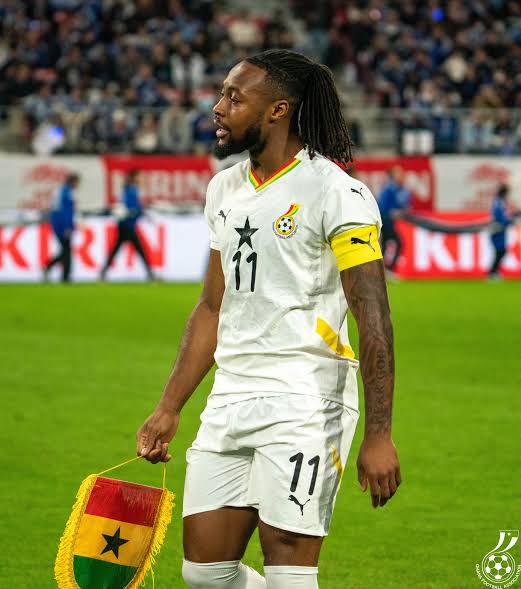
For the Lovers of the Black Stars, few sights are as frustrating as watching Antoine Semenyo torment Premier League defenders, only to witness the same player appear a shadow of himself when wearing the Black Stars jersey days later. The Bournemouth forward now a marquee signing for Manchester City in a £65 million deal has become the emblem of a confusing or hard-to-explain situation in Ghana football. why do some of Ghana’s most talented forwards consistently fail to replicate their club form on the international stage?
The numbers paint a good picture. As of October 2025, Semenyo had registered just three goals and one assist in 27 appearances for the Black Stars . This from a player who, during the same period, established himself as one of the most devastating attacking forces in English football earning Premier League Player of the Month nominations, scoring braces against champions Liverpool, and ultimately commanding a transfer to Manchester City .
The question has become a matter of national debate, from former captains, coaching staff, and the player himself. The answers, it emerges, lie not in a single deficiency but in a complex situation of tactical, cultural, and structural factors that distinguish international football from the club game.
The Player’s Perspective:
Antoine Semenyo himself has offered insight into the challenges facing players transitioning between club and country. Speaking to Joy Sports following Ghana’s impressive World Cup qualifying victories over Chad and Madagascar in March 2025, the forward urged patience from a frustrated fanbase while articulating the fundamental differences between the two environments.
“Every fan is going to have their opinion, and they’re valid,” Semenyo acknowledged. “But I feel like playing for your club and playing for your country are different things. You’ve got to adapt to a manager, adapt to the players, and adapt to surfaces. Everything’s a bit different” .
Semenyo elaborated on several factors that contribute to the adjustment period players face when joining the national team setup. The coaching methodologies, the quality and familiarity of teammates, and even the condition of playing surfaces all vary from the structured environment players enjoy at their European clubs. His advice is to grant players the grace of multiple appearances to find their footing.
“I’ll say just give the players a chance to show themselves over a number of games. It’s not just one game. Just be behind us, even when we have a bad game, and support us. That’s what we ask for,” he added .
The Tactical Disconnect: Otto Addo’s Assessment
Black Stars head coach Otto Addo, himself a product of the German football system, has offered a more technical perspective on Semenyo’s struggles. Following Ghana’s 1-0 victory over Mali in a World Cup qualifier, a match in which Semenyo failed to find the scoresheet. Addo defended the forward’s contribution while highlighting the differences between competitions.
“It is difficult to compare games from Ghana and Africa with Premier League games. All the games have their own nature; they are different,” Addo explained. “Semenyo shines in the Premier League, but for me, even though he didn’t score in that Mali game, he played well” .
This assessment speaks to a broader tactical reality. The Premier League and African football demand fundamentally different skill sets and tactical approaches. The open, transitional nature of many African qualifiers contrasts sharply with the structured tactical frameworks of European club football. Players accustomed to the predictability of weekly training cycles and carefully orchestrated attacking patterns at clubs like Bournemouth, Manchester City must suddenly adapt to a more chaotic, physically demanding environment where preparation time is measured in days rather than weeks.
The 5-1 friendly defeat to Austria in Vienna offered an illustration of these adaptation challenges. While Semenyo showed flashes of brilliance alongside Abdul Fatawu Issahaku in the opening stages, stretching the Austrian defence with pace and urgency, the match exposed a “lack of cutting edge” that has plagued Ghana’s attacking transitions .
The Austrian press noted that Semenyo displayed “flashes of menace but needed greater decisiveness and clinical aggression to punish Austria’s backline”, a critique that could apply to many of his Black Stars appearances .
Cultural Identity and the Language of Connection
Perhaps the most profound explanation for the struggles of foreign-born or overseas-based players comes from former Black Stars captain Stephen Appiah, who led Ghana to its first World Cup appearance in 2006. Appiah, addressing Parliament’s Sport Select Committee in September 2024, located the issue not in tactics but in cultural understanding and emotional connection.
“For us, who grew up here, we understand what it means to wear that jersey,” Appiah stated, drawing a distinction between players raised in Ghana’s football culture and those who join the national team after being developed in European academies .
The former captain highlighted a practical barrier that is rarely discussed in tactical analyses, that is language. Some foreign-born players, he noted, cannot speak any Ghanaian language, creating an invisible wall between them and teammates who might naturally communicate in Twi, Ewe, or Ga during informal moments. This language disconnect extends to cultural practices that bonded Black Stars squads.
Appiah reminisced about an era when players would gather after meals to pray, interact, and strengthen relationships, informal bonding that built the trust and understanding essential for on-field cohesion. This, he suggested, is often missing in the current setup, particularly for players who did not grow up immersed in Ghanaian culture .
“It’s not that they disrespect the coaches,” Appiah clarified. “They just find it difficult to adapt because they don’t understand the culture” .
The irony is that when clubs recognize and honor these cultural roots, the impact can be transformative. Manchester City’s unveiling of Semenyo in January 2026 demonstrated this powerfully. The club’s social media team announced his arrival with a single word in Ewe, “Woezor,” meaning welcome, a gesture that resonated deeply with Ghanaians and acknowledged Semenyo’s heritage from the Volta Region . The announcement drew thousands of celebratory comments, with fans noting that the club had shown a level of cultural sensitivity that, perhaps, could serve as a model for the national team environment itself.
The Limited-Time Challenge: Asamoah Gyan’s Analysis
Former Black Stars captain Asamoah Gyan, Ghana’s all-time leading goalscorer, has offered a more structural explanation focused on preparation time and team continuity. Gyan’s analysis emphasizes the inherent limitations of international football that no amount of talent can fully overcome.
“When you talk about the club side, we have the same players training week in, week out. They know each other’s characteristics and style. But when it comes to the national team, although they see each other sometimes, there are often changes. It’s not like a team that’s been together for a long time,” Gyan explained to TV3 .
This observation cuts to the heart of the matter. At Manchester City Semenyo trains daily with the same teammates, under the same coaching staff, executing patterns of play refined over months. The movements become instinctive; the timing of runs, the weight of passes, the defensive rotations , all internalized through repetition.
In contrast, the Black Stars typically convene for a few days before matches, with squads often featuring new combinations of players across each international window. As Emmanuel Agyemang Badu, another former Black Stars midfielder, noted, players may have “only two or three days to train. This is not enough to understand timing, movement, and player positioning” .
Badu elaborated on the psychological dimension of this compressed timeline. “You come in for a few days, maybe one or two training sessions, and you are expected to deliver immediately. That’s not easy for any player,” he said during a football discussion that drew widespread attention .
Systems and Roles: The Tactics
Another factor identified by analysts and former players is the discrepancy in tactical roles between club and country. At Bournemouth, Semenyo enjoys the freedom to operate across the front line, drifting into central areas, interchanging positions, and serving as a flexible attacking room. His shot volume during the 2025/26 season was extraordinary, averaging 5.7 shots per game, nearly double his previous season’s average, reflecting a system designed to maximize his attacking threat .
With the Black Stars, he plays in a more rigid positional structure. As football fan Robert Kuegbesika told BBC Pidgin: “Semenyo plays on the Right hand side of attack and he can switch positions. But for the Black Stars, they pin him down to either the left or right side the whole game” .
This tactical inflexibility may reflect broader challenges within the national team setup. Sometimes, the conservative nature of Ghana’s tactical approach under various coaches has limited the chances created for forwards. Under Otto Addo, the team plays conservative football; they don’t open up to play fine football. This limits the chances the team creates, and that affects the players.
Coach Otto Addo, for his part, has shown awareness of these challenges. His decision to deploy Semenyo in wide positions reflects tactical necessities, particularly the absence of a natural right winger in the squad at various points but may also limit the forward’s effectiveness . The question of whether Addo’s system can evolve to better accommodate the talents of players like Semenyo remains central to Ghana’s attacking fortunes.
The Weight of Expectation
Beyond tactics and preparation time, former players have identified the psychological burden of representing Ghana as a factor. Emmanuel Agyemang Badu observed that players like Semenyo and Williams sometimes appear to “try to do too much” when wearing the Black Stars jersey.
“You can see the desire,” Badu said. “Sometimes that desire turns into pressure, and pressure affects decision-making” .
This pressure is compounded by the high expectations of a football nation that has grown accustomed to producing world-class talents. When a player dominates in the Premier League, they are widely considered the world’s most competitive domestic competition, fans naturally expect that same dominance to translate immediately to the National team. The reality, as multiple former players have noted, is that international football operates under a different set of demands that cannot be replicated at club level.
Pitch Quality and Environmental Factors
Even the physical environment in which matches are played has been cited as a contributing factor. Following Ghana’s disappointing home performance against Angola in a 2025 AFCON qualifier at the Baba Yara Stadium in Kumasi, analysts noted that the poor pitch conditions affected the team’s ability to play their natural game. The uneven surface disrupted passing rhythms and limited the effectiveness of technically gifted players like Semenyo, Mohammed Kudus, and Thomas Partey .
When Ghana played Niger in Berkane, Morocco, on a superior playing surface, analysts anticipated a more fluid attacking performance that would better suit players accustomed to the good pitches of European stadiums. This highlighted a reality that European-based players face when returning to the African continent, the infrastructure, while improving, does not always match the standards they experience weekly at their clubs .
Signs of Progress: A Turning Point?
Despite the persistent challenges, recent performances have offered cause for cautious optimism. The March 2025 World Cup qualifiers saw Ghana score five goals against Chad and three against Madagascar, with Semenyo, Mohammed Kudus, Inaki Williams, and Ernest Nuamah all previously criticized for their national team contributions getting on the scoresheet .
For Semenyo personally, these matches represented a breakthrough. Having endured a difficult run of form in the Black Stars jersey, the forward’s contributions in the qualifying campaign demonstrated the patience that he had requested from fans beginning to bear fruit.
Coach Otto Addo’s system appears to be evolving to better accommodate his attacking talents. The victory over Madagascar, in particular, saw Ghana’s forward line displaying the kind of fluid movement and clinical finishing that fans had long hoped to see from a group of players whose collective club credentials are among the most impressive in African football.
Looking Ahead
As Ghana prepares for the 2026 World Cup, the challenge of maximizing Semenyo’s contributions remains a central priority for Otto Addo and his technical staff. The forward’s £65 million move to Manchester City in January 2026 further raises the stakes; a player deemed worthy of such investment by one of Europe’s elite clubs carries heightened expectations when representing his country .
The solutions are multifaceted. Continued efforts to build team cohesion through extended training camps and friendly matches may help address the limited preparation time that hampers tactical dexterity. Cultural integration initiatives could help foreign-born players connect more deeply with their Ghanaian heritage and build the informal bonds that Stephen Appiah identified as crucial to team unity. Tactical flexibility from the coaching staff to deploy players in roles that maximize their strengths, rather than forcing them into rigid positional structures, could unlock the kind of attacking fluidity that Semenyo enjoys at club level.
Perhaps most importantly, the patience that Semenyo requested from Ghanaian will be essential. The temptation to judge players on isolated performances is understandable in a country where football is both passion and identity. Yet as multiple former captains and analysts have noted, the transition from club star to national team is really difficult
As Asamoah Gyan wisely said, “When they keep playing together consistently, they’ll regain their confidence and perform well as a unit” . For Antoine Semenyo and the Black Stars, the journey toward that consistency continues with the promise of what awaits at the end of it worth every moment of patience along the way.