
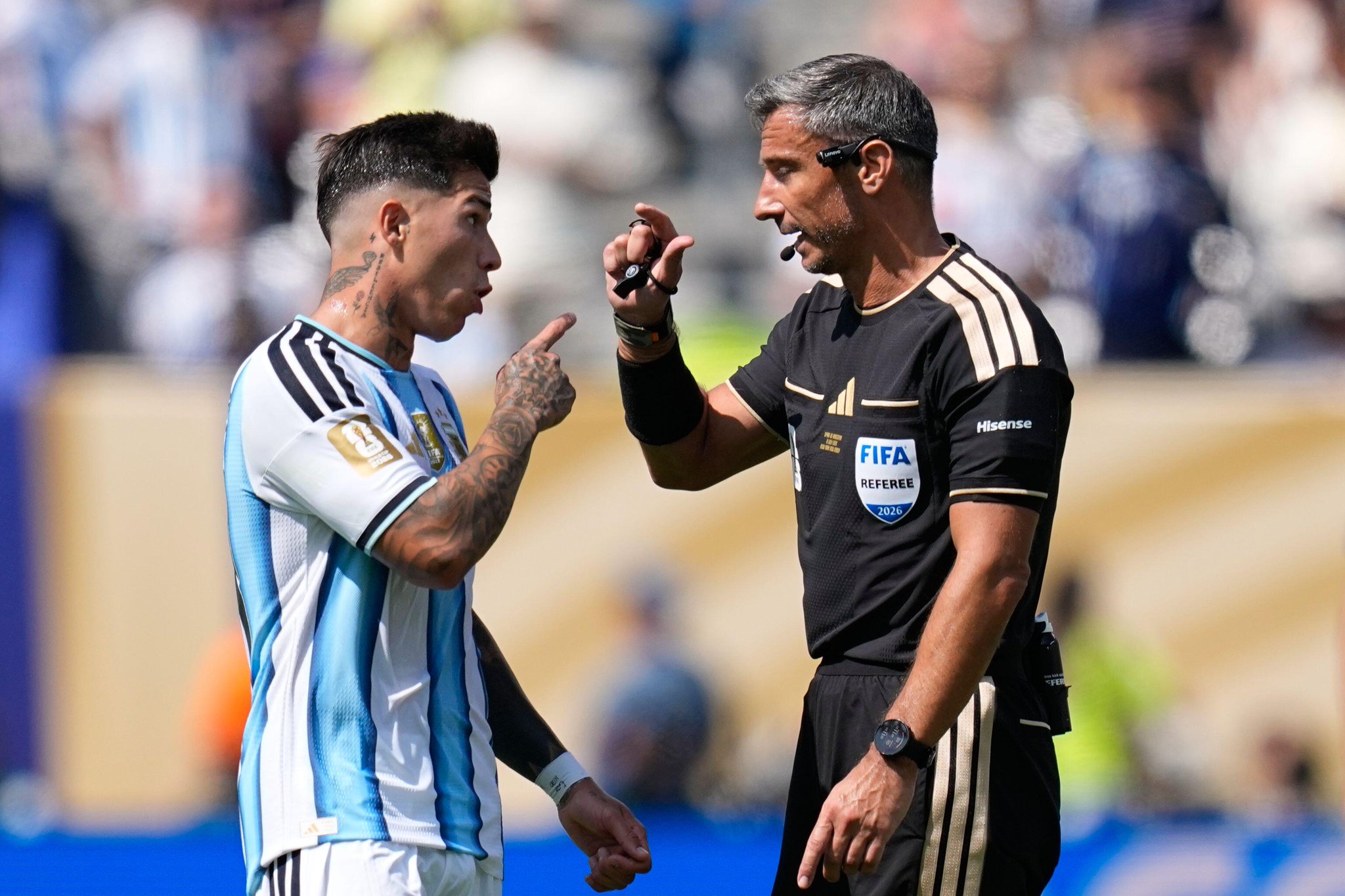
Buenos Aires never had a shortage of drama in football’s biggest showpiece, and Sunday’s World Cup final was no exception, as Enzo Fernández’s dismissal etched Argentina’s name further into an infamous corner of tournament history.
The Chelsea midfielder was shown a second yellow card, and with it a red, deep into stoppage time of the second half against Spain in Sunday’s final, becoming only the sixth player ever sent off in a men’s World Cup final and the third Argentine to suffer that fate.
Fernández’s dismissal came in the 93rd minute, after a first caution in the 82nd minute for dissent following a string of fouls. The decisive moment arrived when he collided heavily with Spain’s Pau Cubarsí, a challenge referee Slavko Vinčić deemed worthy of a second booking. Argentina were reduced to ten men for the remainder of a game that would go on to extra time, before Spain’s Ferran Torres settled the contest to hand La Roja their second World Cup crown.
The red card was no isolated incident in Argentine World Cup final history. In 1990, Pedro Monzón and Gustavo Dezotti were both dismissed in the same final against West Germany, a match Argentina lost 1-0. Thirty-six years later, Fernández joined that unwanted club, giving Argentina three of the six red cards ever issued in a World Cup final, more than any other country.
Argentina’s physicality was a recurring storyline throughout their run to the final, and it proved costly in the end. Several other Argentine players were cautioned during Sunday’s match, including Leandro Paredes, Lisandro Martínez, and Cristian Romero, underlining the disciplinary toll the team paid in pursuit of a second star.
For Fernández, the moment will likely define his final in Argentine football history not for a goal or a decisive pass, but for continuing a pattern of ill discipline that has now shadowed the Argentina across three different World Cup finals, 36 years apart.