
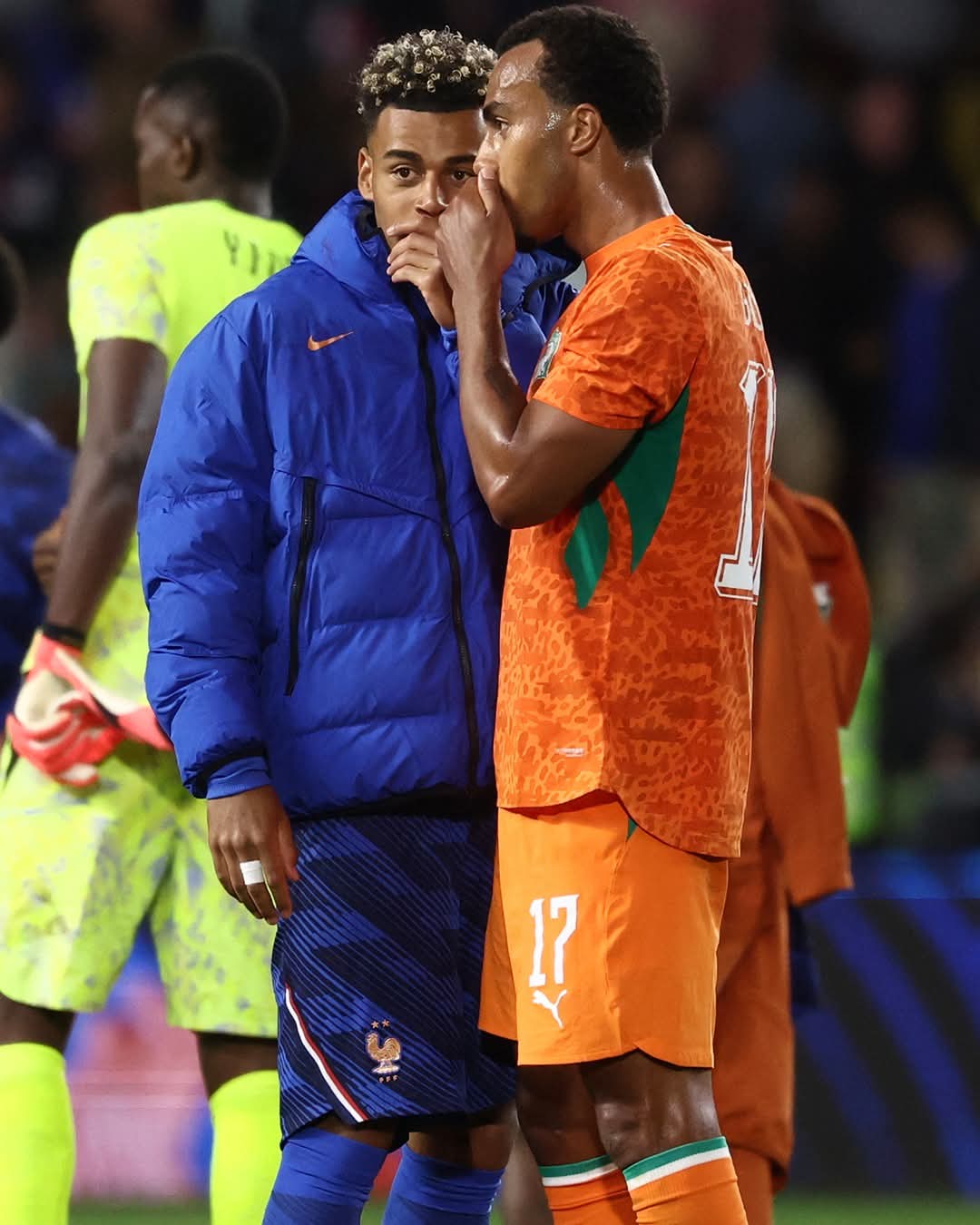
Eight pairs of siblings from ten different countries across four continents are set to play at the tournament. Considering that only 736 players are selected from millions around the world, having even one family produce two World Cup players is rare. Having eight pairs appear at the same tournament is truly remarkable.
The younger Doué has emerged as one of European football’s most electrifying attacking talents, with his elder brother representing Les Éléphants.
Ghana and Spain field the Williams brothers, born in Bilbao to Ghanaian parents, in a narrative that defines the dual-heritage dimension of modern international football.
Brian Brobbey’s physicality and clinical finishing have made him a fixture in Ronald Koeman’s Netherlands setup, while his brother carries Ghanaian heritage to Group L.
The Souttar brothers, both central defenders, represent a remarkable split of international allegiance Scotland and Australia on football’s largest platform.
The only fraternal pairing to appear in the same national squad, the Hernandez brothers give France a rare brotherhood at the heart of Les Bleus’ defensive structure.
Like the Hernandezes, the Timber twins both serve the same Dutch national cause a pairing that reflects the extraordinary depth of a Netherlands squad that is a genuine contender.
Cape Verde’s historic qualification is made the sweeter by the Duarte brothers’ shared presence on the world stage for the first time.
Brothers Leandro and Juninho Bacuna represent one of football’s smallest countries on the world stage, embodying the tournament’s expanded reach under its 48-team format.
The William Brothers: The Story Ghana Calls it’s own.
Among the eight pairs, none carries greater significance for Ghanaian football than Iñaki and Nico Williams. Born in Bilbao to Ghanaian parents who made the journey from Ghana to Spain in 1996, the Williams brothers represent one of football’s most compelling dual-heritage narratives. Iñaki, the elder, selected to represent the Black Stars after years in the Spanish youth system, becoming one of the most high-profile players ever to wear the national shirt. Nico, the younger, committed to Spain and went on to win UEFA Euro 2024 as one of the tournament’s standout performers.
Cross Border Pairings
Four of the eight sibling pairs will represent different countries at the 2026 FIFA World Cup. These include the Doué brothers (Côte d’Ivoire and France), the Williams brothers (Ghana and Spain), the Brobbey brothers (Ghana and the Netherlands), and the Souttar brothers (Scotland and Australia).
These families reflect the global nature of modern football, where migration, dual nationality, and diaspora communities influence international teams. Many of the split-nationality siblings have roots in West Africa, especially Ghana and Côte d’Ivoire, highlighting the continued impact of African heritage on world football even when players represent European countries.
The Brobbey brothers are another example of Ghana’s strong football connections across Europe. Brian Brobbey is one of the Netherlands’ key attacking players, known for his strength and goal-scoring ability. His brother, meanwhile, represents Ghana, adding depth to a Black Stars squad preparing to face England, Panama, and Croatia in Group L.
Duarte and Bacuna
Perhaps the most emotional part of this story is what it means for Cape Verde and Curaçao. Both countries are new or relatively new to the World Cup stage, and both arrive with a pair of brothers in their squads. For the Duarte brothers of Cape Verde and the Bacuna brothers of Curaçao, playing at the 2026 World Cup is more than personal success, and proof that smaller football nations can shine on the world stage.