
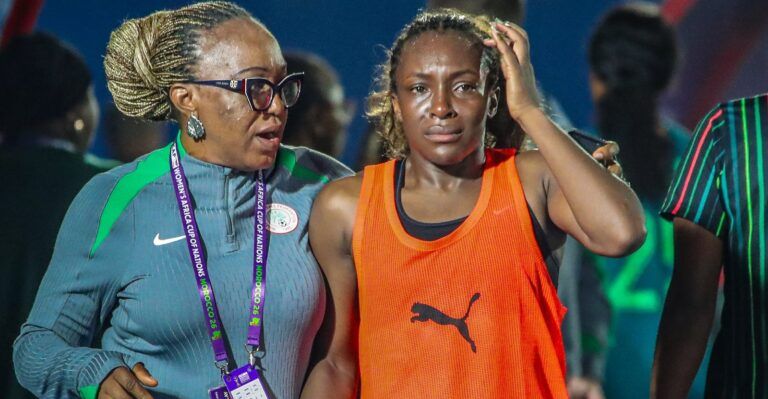
Super Falcons: A Streak Broken in Casablanca
Nigeria’s road to the 2027 World Cup narrowed sharply at the ongoing Women’s Africa Cup of Nations (WAFCON) in Morocco, where the Super Falcons were eliminated in the quarter-finals by Cameroon’s Indomitable Lionesses, beaten 1-0 through a first-half strike from Myriam Nyadjou.
Under the CAF qualifying format, only the four teams reaching the WAFCON semi-finals earned automatic tickets to Brazil 2027, so the loss to Cameroon immediately cost Nigeria a direct route to the tournament.
A second chance remained through the play-offs, pitting Nigeria against fellow quarter-final losers for two remaining places in the FIFA Intercontinental Play-Off Tournament.
Drawn against South Africa’s Banyana Banyana in Casablanca, the Super Falcons could not find a way through. Thembi Kgatlana put the South Africans ahead in the 56th minute before Refiloe Jane doubled the lead in the 77th.
A late red card gave Nigeria a lifeline, and Christy Uchebe converted the resulting penalty, but the goal came too late to force extra time, and South Africa held on for a 2-1 win.
How Nigeria’s World Cup Hopes Unravelled
Nine Appearances, One Enduring Symbol
What makes the miss so jarring is the record it breaks. Nigeria had played at all nine editions of the Women’s World Cup from the tournament’s launch in China in 1991 through to Australia and New Zealand in 2023, the only African side never to have missed one.
Results on the pitch were often modest by that standard, most campaigns ended at the group stage, and Nigeria carries the unwanted distinction of the most defeats and the most goals conceded in the competition’s history, but the presence itself was the point.
Season after season, the Super Falcons were Africa’s guaranteed representative at the Women’s World Cup.
The team’s two standout runs bookend that history. Nigeria reached the quarter-finals at the 1999 tournament in the United States, still regarded as the high-water mark of African performance at a Women’s World Cup, and came closest to matching it in 2023, when a battling group-stage campaign in Australia carried the Super Falcons into the Round of 16 and drew praise for a side that competed toe-to-toe with established footballing countries.
Those two tournaments, 24 years apart, were the clearest evidence that Nigeria could do more at a World Cup than simply turn up.
A Huge Blow for African Football?
Nigeria’s absence lands as more than a domestic setback. For over three decades, the Super Falcons functioned as African women’s football’s most visible ambassador at the World Cup, a ten-time WAFCON champion whose participation was never in doubt even when advancement beyond the group stage was.
Their exit removes the continent’s most recognisable name from Brazil 2027 and leaves South Africa and Ghana, both still fighting through the intercontinental play-off route, carrying a heavier share of the continent’s World Cup representation.
It also arrives alongside a wider result at WAFCON 2026 itself. Nigeria’s exit in the tournament’s quarter-finals was its earliest ever, the first time in the competition’s history that the Super Falcons had failed to reach the last four.
Taken together with the play-off defeat, it marks the heaviest tournament cycle Nigerian women’s football has faced, and raises a genuine question for the sport on the continent. If Africa’s most decorated and most consistent women’s team can miss a World Cup entirely, competition among the continent’s chasing pack may be closing in on the established order faster than expected, a development that cuts both ways for African football’s growth on the world stage.