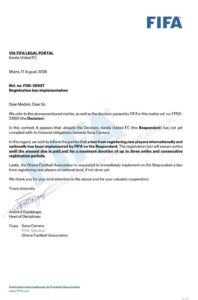
Karela United FC has been placed under a FIFA registration ban after failing to settle a financial obligation owed to Sana Camara, in a notice issued by FIFA’s Disciplinary Committee on 17 August 2026.
The sanction bars the Aiyinase-based club from registering new players both internationally and nationally with immediate effect.
The ban stems from Karela United’s non-compliance with a prior FIFA ruling, identified in correspondence as Decision FPSD-23160, which had ordered the club to meet its financial obligations towards Camara.
According to the notice, signed by Américo Espallargas, FIFA’s Head of Disciplinary, the club had “not yet complied with its financial obligations” despite the earlier decision.
Under the terms of the sanction, the registration ban remains in force until the outstanding amount is paid in full, capped at a maximum of three complete and consecutive registration periods.
FIFA also formally requested the Ghana Football Association to immediately implement a corresponding national-level registration ban on Karela United, should it not already be in place.
FIFA notices of this kind are issued under the overdue-payables framework of the Regulations on the Status and Transfer of Players (RSTP), rather than as a fresh disciplinary charge.
Sanctions of this nature typically follow a set sequence rather than being imposed abruptly.
A club that falls behind on a contractual financial obligation to a player, agent, or another club can be placed in default once payment is overdue, giving it a further window to pay before the matter escalates.
Where a club still fails to pay after FIFA’s Football Tribunal has already ruled on the underlying dispute, the Disciplinary Committee can move directly to enforcement measures without the creditor having to file a fresh complaint, a streamlining introduced in FIFA’s 2019 reforms specifically to stop debtor clubs from running out the clock on cooperative parties.
The available sanctions escalate from a warning or reprimand, through fines, up to a registration ban. A full ban of the kind imposed on Karela United is generally reserved for cases where a prior FIFA decision on the debt already exists and has gone unpaid.
The three-registration-period ceiling referenced in the letter reflects a 2021 amendment that raised the previous two-period cap, giving unpaid creditors stronger leverage to secure payment.
What It Means for Karela United
Until the debt to Camara is cleared, Karela United will be unable to register new signings for competitive football at either the domestic or international level, a restriction that would affect any transfer business the club looks to conduct in upcoming registration windows. The ban does not, on the face of the notice, affect players already registered with the club or their eligibility to continue playing.
The Ghana Football Association’s role is now to give domestic effect to the FIFA instruction, meaning the enforcement of the ban within the Ghana Premier League and lower-tier competitions falls to the national body.