
Ghana’s Fastest Men Are Making History – But Fighting the System to Do It
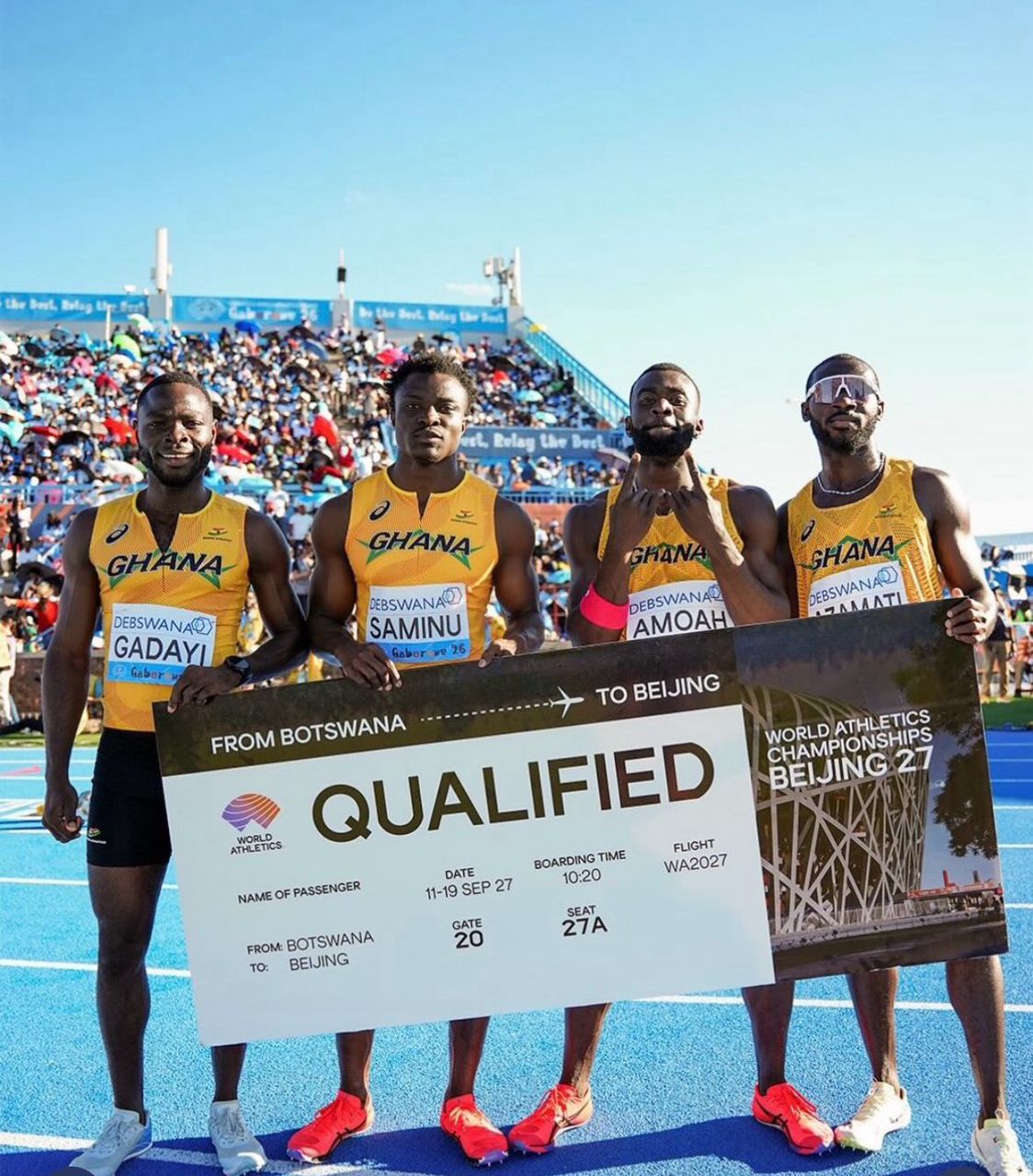
Ghana’s men’s 4x100m relay team should have returned from Botswana with nothing but praise ringing in their ears.
Instead, one of the greatest achievements in recent Ghanaian athletics has once again exposed the deeper struggles facing some of the country’s most promising sportsmen.
After clocking 38.09 seconds to finish second and secure qualification for the 2027 World Athletics Championships, Ghana’s relay quartet once again proved they belong among the world’s elite. It marked another major milestone for a team that has now qualified Ghana for four consecutive World Athletics Championships and back-to-back Olympic Games.
But moments after the celebrations, the spotlight shifted away from the track.
Ghana’s 100m record holder Abdul-Rasheed Saminu publicly criticised the travel arrangements made ahead of the World Relays, alleging that members of Team Ghana endured a gruelling 14-hour flight and a 16-hour layover before arriving for competition.
“The Ministry of Sports in Ghana needs to do better. Don’t set us up for failure,” Saminu wrote on social media.
Teammate Benjamin Azamati soon added his frustration, revealing that while rival nations had spent between one and three weeks in Botswana preparing, Ghana’s athletes were still in transit and only arrived a day before competition.
“To add to that, we’re competing against guys who’ve been here one to three weeks while we’ve been travelling since Wednesday and arriving a day before on a new continent. Do better, Sports Ministry,” Azamati posted.
The comments quickly sparked public debate, forcing both the Ghana Athletics and the Ministry of Sports and Recreation to respond.
In a statement, Ghana Athletics accepted full responsibility for the concerns raised by the athletes and pledged to work closely with the Ministry to ensure such challenges do not happen again.
“We take full responsibility for these concerns and acknowledge the importance of proper preparation conditions for elite performance,” the association said.
However, the Ministry of Sports and Recreation later issued its own clarification, insisting that all travel arrangements for Team Ghana at the World Relays were based on schedules submitted by Ghana Athletics.
The Ministry added that no alterations were made from their end.
While the back-and-forth between both institutions may have addressed the immediate issue, for many within Ghana athletics, the travel controversy is only the latest chapter in a much bigger story.
Ghana Athletics president, Bawah Fuseini, speaking on Sporty FM Ghana, admitted that inadequate funding continues to affect athlete preparation.
“Our athletes’ preparations have always been an issue. It’s a matter of funding,” Fuseini said.
“If we have the financial muscle to camp our athletes for even one week before competitions, it’ll be very helpful.” He added.
The challenges facing Ghana’s athletes have long stretched beyond flight bookings.
In 2023, Ghana was forced to withdraw from the men’s 4x100m relay at the World Championships after two athletes picked up injuries, with no reserve available to replace them.
At the recently concluded World Relays in Botswana, Ghana’s delegation reportedly consisted of just four athletes and one coach.
There was no reserve athlete, no physiotherapist, no nutritionist, and no dedicated recovery personnel, leaving athletes to manage their own recovery in the middle of world-class competition.
Sources close to the team say some athletes even had to rely on support from competitors from other countries.
The preparation issues were also highlighted by the late inclusion of Edwin Gadayi, who reportedly had to travel by road from Kumasi to Accra to catch a last-minute flight to Botswana following changes within the team.
Elsewhere, Ghana’s high jump record holder Rose Yeboah has also spoken in the past about travel difficulties and inadequate competition kits during major championships.
Yet despite these recurring challenges, Ghana’s athletes continue to produce results.
The current relay team remains one of the country’s brightest medal prospects, having consistently competed with the world’s best while recording some of the fastest times in Ghana’s history. At the last World Championships, the team finished within fractions of a second of a podium place.
Their latest qualification in Botswana is further proof that Ghana may be witnessing a once-in-a-generation group of athletes capable of competing for global medals, and potentially gold.
The question now is whether the structures around them will match their ambition before that opportunity slips away.