

Iran’s Silent Message of Unity Echoes Beyond Belgium Draw as Political Tensions Shadow World Cup Campaign
Iran’s second outing at the 2026 FIFA World Cup ended in another disciplined display, but it was what happened after the final whistle in Los Angeles that drew global attention.
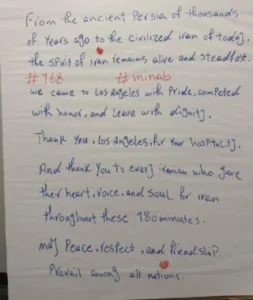
Following a hard-fought 0-0 draw with Belgium in Group G, members of the Iranian squad left a handwritten note in their dressing room. The message, later released by the Iranians carried an appeal for peace and unity at a time of political strain between Iran and the United States.
The result itself strengthened Iran’s position in the group after an opening 2-2 draw with New Zealand, leaving them with two points and everything to play for heading into their final fixture against Egypt. But the tone set by the players off the pitch quickly overshadowed the football narrative.
The gesture arrived in a tournament already shaped by diplomatic friction, travel restrictions, and uncertainty surrounding Iran’s participation in matches hosted in the United States.
A Dressing Room Statement That Reached Beyond the Pitch
Inside the stadium in Los Angeles, Iran’s players left behind a message that blended national identity, gratitude, and an appeal for unity.
“From the ancient Persia of thousands of years ago to the civilised Iran of today, the spirit of Iran remains alive and steadfast,” the note read.
“We came to Los Angeles with pride, competed with honour, and leave with dignity.”
The message also thanked the host city and supporters who had followed their journey through difficult circumstances.
“Thank you Los Angeles for your hospitality. And thanks to every Iranian who gave their heart, voice and soul for Iran throughout these 180 minutes.”
It ended with a broader appeal that stood out amid the political backdrop of the tournament. “May peace, respect and friendship prevail among all nations.”
The statement was not only reflective but deliberate, arriving at a moment when sport, diplomacy, and tension were intersecting on the world stage.
Political Pressure Around Iran’s Tournament Presence
Iran’s participation in the World Cup has unfolded under strict logistical constraints and political scrutiny linked to strained relations between Iran and the United States, one of the co-hosts of the tournament alongside Canada and Mexico.
Security concerns and visa complications forced Iran to relocate their base from the United States to Mexico ahead of the competition. Reports indicated that several members of their backroom staff were denied entry visas, while the federation raised concerns over fairness in tournament arrangements.
Further restrictions have shaped their movement throughout the competition, with Iran required to enter the United States only shortly before matches and leave immediately after.
These conditions created an unusual competitive environment and prompted criticism from within the camp. Head coach Amir Ghalenoei previously described his squad as the “most oppressed” at the tournament, reflecting frustrations over the logistical and political hurdles surrounding their campaign.
Despite the challenges, Iran have remained competitive on the pitch, taking points from both of their opening matches and staying in contention for qualification.
Football, Diplomacy, and a Symbolic Gesture
Beyond the result against Belgium, the handwritten note has become a focal point in discussions around Iran’s World Cup story.
The timing is significant, coming as diplomatic conversations continue between Iranian and United States officials over easing restrictions and managing tensions linked to security and travel arrangements during the tournament period.
The gesture has been interpreted by observers as more than a post-match courtesy. It sits at the intersection of sport and diplomacy, where national teams often become informal ambassadors during global events.
The Football Federation of Iran’s decision to publish the note ensured its message reached a wider audience, reinforcing themes of respect and shared humanity at a moment when political divisions remain unresolved.
There was also a reference within the statement to the wider human toll of conflict, including mention of a deadly attack on a girls’ school in Minab, which added a somber layer to an otherwise sporting context.
Iran now turn their attention to their final Group G match against Egypt, where qualification for the knockout stage remains within reach. Yet regardless of what happens on the pitch, their most widely discussed contribution so far may not be the draw with Belgium, but the message they chose to leave behind in silence after the final whistle.