
141 National Team Wins
4 World Cup Qualifications
260 Matches as NT Coach
54.2% Win Rate
40+ Years in Management
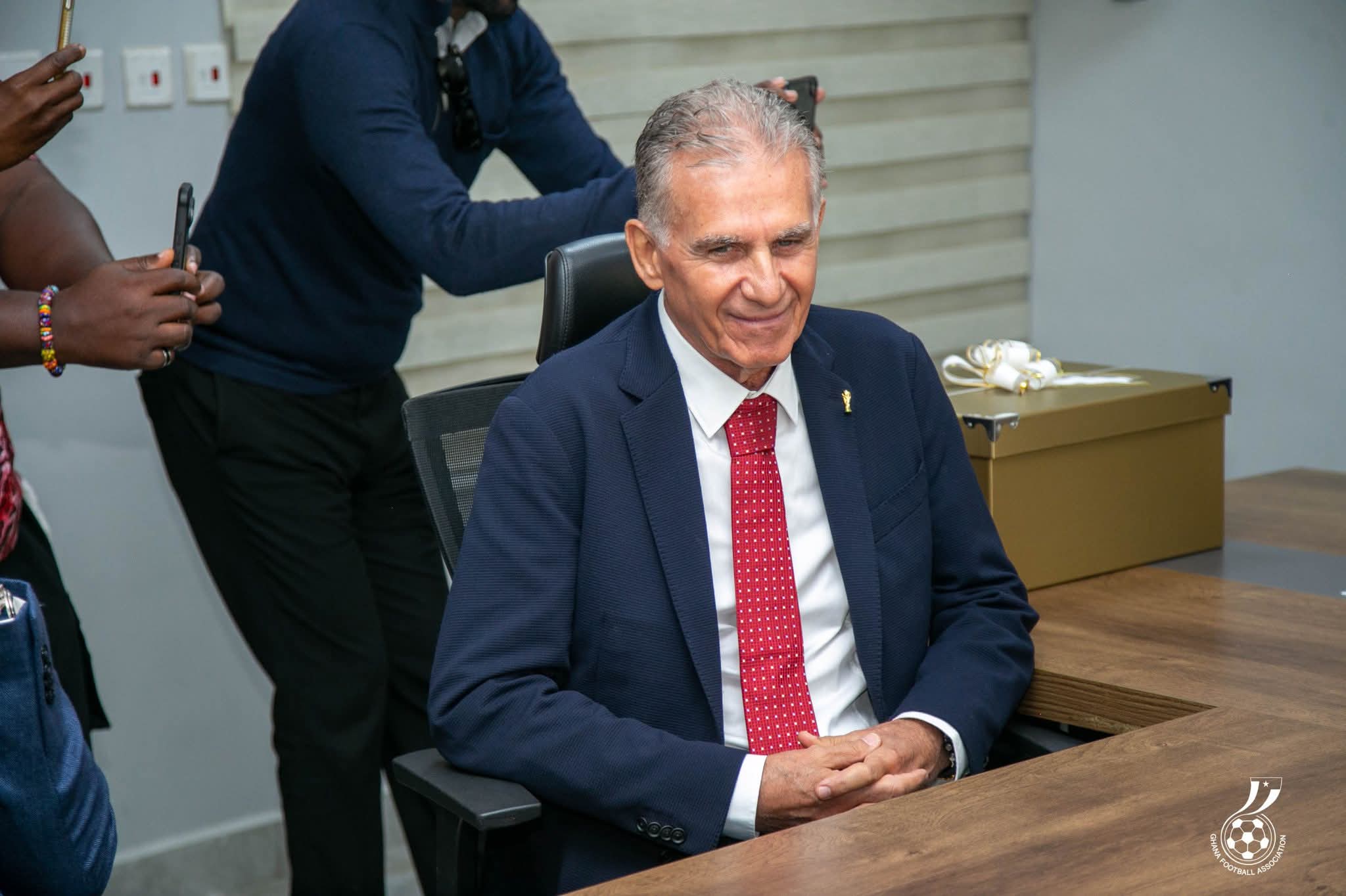
In April 2026, Carlos Manuel Brito Leal de Queiroz accepted an invitation from the Ghana Football Association to assume the position of Head Coach of the Black Stars. With that decision, one of football’s most decorated and widely travelled managers adds a new chapter to a career that spans five continents, eight national teams, and more than four decades of elite-level service to the game.
The appointment carries weight beyond the immediate. Should Queiroz guide Ghana to the FIFA World Cup 2026, to be hosted across the United States, Canada, and Mexico, he will become only the second coach in football history, after Bora Milutinovic to compete in five consecutive World Cup tournaments.
It is a distinction that reflects not merely longevity, but a sustained capacity to prepare and elevate national teams at the highest level of international competition.
Never lie to football. Team above all and everything.” Carlos Queiroz
A Career Built on Transformation
Queiroz was born on the 1st of March, 1953, in Nampula, Mozambique. His managerial career began in 1983, when he took charge of Belenenses’ Under-15 side. Within a year, he had joined the Portuguese Football Federation’s technical board, and by 1987 he was appointed Head Coach of Portugal’s Under-20 national team, a role that would define the early arc of his legacy.
Under his guidance, a generation of Portuguese talent was forged. Players who would later be collectively celebrated as the “Portuguese Football’s Golden Generation” among them Luís Figo, Rui Costa, João Pinto, Paulo Sousa, and Fernando Couto were shaped in their formative years by Queiroz’s training methodology and philosophical approach to the game.
The results were immediate, back-to-back Under-20 World Cup titles in Riyadh in 1989 and Lisbon in 1991, alongside an Under-16 European Championship in the same period.
1989: U-20 World Cup
Riyadh: 1991
U-20 World Cup: Lisbon
1989: U-16 European Champions
The Making of a Global Authority
From youth football’s summit, Queiroz ascended to the senior Portugal national team in 1991. He then pursued club management across three continents, Sporting C.P. in Portugal, New York MetroStars in the United States, and Nagoya Grampus Eight in Japan, where he delivered a Japanese Super League title. Each posting deepened a coaching philosophy rooted in tactical organisation, player development, and structural discipline.
In 1998, Queiroz returned to international management with the United Arab Emirates. He subsequently guided South Africa to qualification for the 2002 FIFA World Cup in Korea and Japan, an achievement that would stand as the last time the South African national team reached a World Cup final stage. That qualification marked the first of what would become four World Cup qualifications with different national associations, a record in international football.
Between 2002 and 2008, with a one-season interruption for the head coach role at Real Madrid where he claimed the Spanish Supercup, Queiroz served as Assistant Manager and First Team Coach at Manchester United under Sir Alex Ferguson. During that period, he was integral to a side that won three Premier League titles, one UEFA Champions League, the FA Community Shield, and the League Cup. The breadth of his involvement at Old Trafford affirmed his credentials at the elite club level, even as his enduring vocation remained the international game.
Iran, Colombia, Egypt: A Pattern of Elevation
Queiroz’s longest and arguably most impactful chapter in national team management came with the Republic of Iran, whom he served across two separate spells spanning the years 2011 to 2022. In his first tenure, he accomplished something unprecedented in football history: guiding Iran to consecutive World Cup final stages, Brazil 2014 and Russia 2018 with two different qualification campaigns. No coach had previously achieved four World Cup qualifications with different national teams.
In Russia, Iran’s performances drew widespread admiration. The team defeated Morocco, held Portugal to a draw, and challenged the second stage of the tournament until the final moments of their group fixtures. Prior to the World Cup, Iran qualified for Russia 2018 with an extraordinary 12-match, 1,108-minute run without conceding a single goal. In the 2019 Asian Cup, under Queiroz’s direction, Iran reached the semi-finals for the first time in fifteen years, losing only to Japan, Asia’s most successful footballing nation across that era.
With Colombia in 2019, Queiroz orchestrated a Copa América campaign of considerable distinction. The side defeated Argentina, Qatar, and Paraguay in the group stage recording nine points with a clean sheet record before falling to Chile on penalties in the quarter-finals, exiting without having conceded a single goal across the entire competition.
The 2–0 victory over Argentina was Colombia’s first against them in twelve years and nine attempts.
His tenure with Egypt from 2021 to 2022 yielded a 65% win rate across 20 matches. Queiroz steered the Pharaohs to the Arab Cup semi-finals, the Africa Cup of Nations final, and the 2022 World Cup qualification playoff, all while introducing new personnel and establishing a platform for renewal within the squad.
Both of the losses incurred en route to those finals came against Senegal, and both were decided by penalty shootout.
Where Records Stand
Across 260 international matches as a senior national team head coach, Carlos Queiroz has accumulated 141 victories the highest total in the history of the position. Among coaches who have surpassed one hundred wins in international football, only Mário Zagallo of Brazil, with a win rate of 65.7%, and Joachim Löw of Germany, at 62.6%, rank above him in efficiency. Queiroz’s 54.2% win rate places him third in that elite group, ahead of Milan Macala, Óscar Tabárez, Carlos Alberto Parreira, Claude Le Roy, and Bora Milutinovic.
Beyond direct managerial statistics, Queiroz has served as a FIFA Instructor and FIFA Technical Advisor. He was appointed USA National Team Technical Director in the late 1990s, authoring the Q-Report, the foundational document for Project 2010, the long-term development plan for American football. He was also selected to serve as the World Star FIFA Team Coach on two occasions, facing Bosnia in April 2000 and France in August 2000.
The Mission Ahead: Black Stars, World Cup 2026
Carlos Queiroz arrives in Ghana with a clear and singular objective.
To guide the Black Stars to the FIFA World Cup 2026. His record as an architect of World Cup qualification campaigns across South Africa, Portugal, and Iran provides a precise and relevant template for what the task demands. His capacity to work with teams in transitional period, to introduce fresh talent alongside experienced personnel, and to establish defensive solidity as a foundation for competitive performance has been demonstrated consistently across continents and confederations.
Ghana’s football heritage is rich. The Black Stars have appeared at four World Cup tournaments, with a memorable run to the quarter-finals in 2010, and the country possesses a tradition of producing technically gifted, athletically formidable players. Under Queiroz, the task is not merely to qualify, but to build a structure capable of making a meaningful contribution to the world stage.
For Ghana, the appointment represents a statement of ambition. For Queiroz, it is the continuation of a job pursued with extraordinary consistency one that, should it culminate in World Cup qualification, will etch his name into the record books once again. After Bora Milutinovic, he will become only the second manager in the history of football to have competed at five consecutive FIFA World Cups.
Team above all and everything” it is a philosophy that has underpinned four decades and eight nations. It now belongs to Ghana
Source: GFA