
The Choice Before Africa: CAF Weighs Football’s Future as FIFA Pushes FFE Proposal
The countdown to FIFA’s September 19 deadline has intensified scrutiny of the governing body’s controversial FIFA Forward Enterprise (FFE) proposal. What began as a commercial restructuring plan has evolved into one of the biggest governance debates in football, forcing member associations to decide whether to support FIFA’s vision or reject it over concerns about the future ownership of the sport’s biggest competitions.
FIFA President Gianni Infantino has maintained that the proposal is designed to unlock the commercial potential of FIFA-owned tournaments, including the FIFA World Cup, by creating a new entity that would oversee their commercial rights and operations while attracting private investment. According to FIFA, the initiative would generate greater revenues that could be redistributed to member associations.
The proposal, however, has drawn fierce criticism from those who believe football’s premier competitions should never become investment assets. Critics argue that allowing private investors to acquire ownership interests in the World Cup would fundamentally change the way the game is governed and potentially place commercial interests ahead of football’s long-term welfare.
Opposition has gathered momentum rapidly. UEFA’s 55 member associations unanimously rejected the proposal, describing the World Cup as an asset that belongs to football rather than private investors. Europe’s governing body also warned that its members would not participate in FIFA competitions should ownership interests in FIFA tournaments be transferred to external investors.
The resistance expanded further when CONCACAF became the second confederation to publicly oppose the proposal. Coming just days after FIFA announced its September 19 deadline for member associations to communicate their position, the North and Central American confederation’s response has added further pressure on FIFA’s leadership.
With Europe and CONCACAF now united in opposition, attention has shifted to the remaining confederations, particularly CAF, whose eventual position may prove one of the most influential in determining whether the proposal gains broad global acceptance or encounters overwhelming resistance.
For Africa, the issue extends beyond football politics. CAF’s 54 member associations must decide whether the financial opportunities presented by the proposal outweigh concerns about the future governance of world football.
The Numbers Make Every Confederation Matter
Although FIFA has presented the FFE as a proposal for consultation rather than a traditional election, the arithmetic behind member associations’ decisions remains significant.
FIFA has 211 member associations, meaning support from at least 106 associations would represent a simple majority.
UEFA accounts for 55 members, while CONCACAF has 41. Together, they represent 96 associations that have already indicated opposition to the proposal.
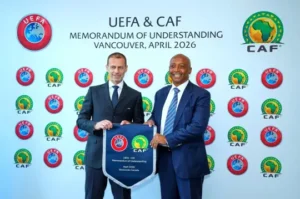
That leaves the two confederations just ten associations short of reaching a majority. Interestingly, CONMEBOL has exactly ten member associations.
Should every South American federation align with UEFA and CONCACAF, opposition to the proposal would immediately reach the 106-association threshold.
Whether that happens remains uncertain, but it illustrates how quickly the balance could shift depending on the decisions taken by the remaining confederations.
CAF Faces a Choice Beyond Football Politics
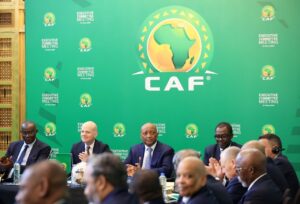
Among all the remaining confederations, none arguably faces a more delicate decision than CAF.
African football continues to battle infrastructure deficits, limited commercial revenues and financial constraints across many national associations. Additional investment could accelerate stadium development, youth academies, women’s football programmes, coaching education and grassroots initiatives.
Reports surrounding the proposal suggest member associations could receive around $40 million through the new commercial structure. For many African federations, such funding would represent one of the largest financial injections in their history.
That reality inevitably makes the proposal attractive from a development standpoint.
However, CAF must also consider the wider implications.
The central concern raised by UEFA is not about increasing football’s revenues but about allowing private investors to acquire ownership interests in competitions that have historically belonged to FIFA’s member associations.
For many observers, this is where the debate becomes more complicated than simply accepting or rejecting additional funding.
It becomes a question of whether immediate financial benefits justify a permanent structural change to the governance of world football.
Development Versus Long-Term Control
There is little disagreement that football requires greater investment. The disagreement concerns the mechanism through which that investment should be generated.
Supporters of the proposal argue that football has become an increasingly commercial industry and that attracting private capital is a logical step toward maximizing the value of FIFA competitions.
Opponents insist there is a significant difference between selling sponsorships or broadcasting rights and allowing investors to obtain ownership interests in football’s most prestigious tournaments.
That distinction explains UEFA’s uncompromising position.
Its leaders believe commercial partnerships should never extend to ownership of competitions such as the World Cup, regardless of the financial rewards involved.
CAF must now determine where it stands within that debate.
September 19 Could Mark a Turning Point
As the deadline approaches, lobbying is expected to intensify across every confederation.
FIFA will continue promoting the proposal as an opportunity to strengthen football development worldwide through increased revenues.
UEFA and CONCACAF, meanwhile, are likely to continue encouraging member associations to reject any plan that introduces private ownership into FIFA competitions.
For CAF, the decision will carry consequences far beyond Africa.
Supporting the proposal could unlock substantial funding capable of transforming football development across the continent. Rejecting it would reinforce the argument that football’s biggest competitions should remain entirely under the collective ownership of FIFA’s member associations.
Ultimately, September 19 is not simply about whether associations support or oppose one commercial proposal. It is about determining the direction football takes over the coming decades.
The decision each member association makes could influence not only the future of the World Cup, but also the balance between commercial ambition and the preservation of football’s institutional independence.