
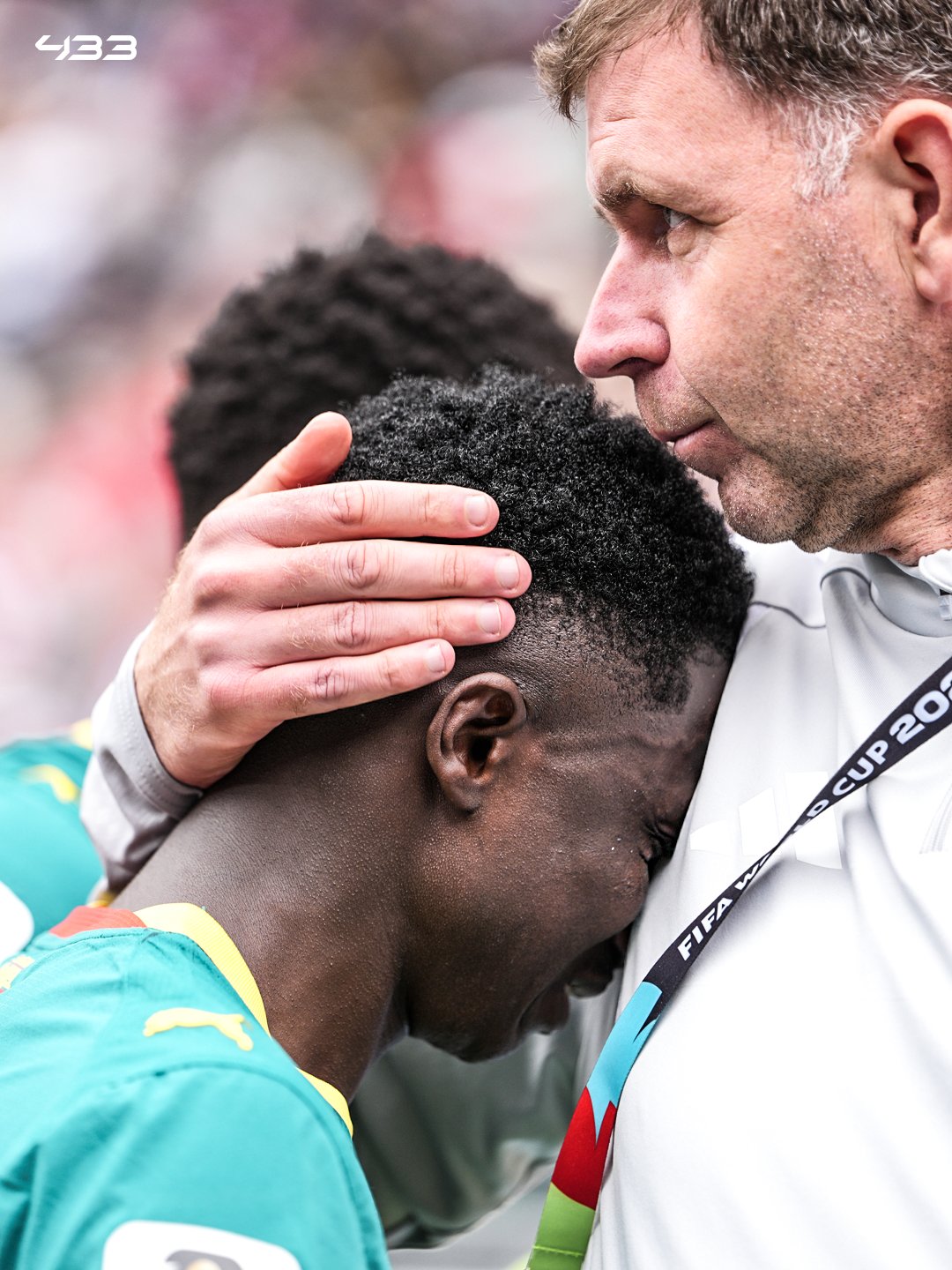
It has a name now, even if nobody wanted to coin it. Commentators call it the “late curse.” Statisticians call it a small-sample coincidence. Fans across the continent, watching their teams get pulled apart in stoppage time and extra time year after year, call it something closer to heartbreak. Whatever the label, the pattern is real enough stretching back thirty-six years and the 2026 World Cup has already added four fresh, painful chapters to it.
Where It Started: Naples, 1 July 1990
Cameroon’s run to the 1990 quarter-finals remains one of the most romantic stories in World Cup history. The first African team ever to reach the last eight, built on the fading brilliance of a 38-year-old Roger Milla and a defence that had already knocked out reigning champions Argentina.
Against England in Naples, the Indomitable Lions did something extraordinary, trailing 1-0 to a David Platt header, they came storming back through two second-half goals — Emmanuel Kunde’s penalty in the 61st minute and Eugène Ekéké’s finish four minutes later — to lead 2-1 deep into the second half.
That lead held for eighteen minutes. In the 83rd minute, Gary Lineker was felled in the box by Benjamin Massing and converted the resulting penalty to level the score. The match went to extra time, where Lineker struck again from the spot in the 105th minute, sending England through 3-2 and Cameroon home. It was not, strictly, a collapse in the game’s final ten minutes of normal time, the equaliser arrived with seven minutes left, and the decisive blow came in extra time but the shape of the afternoon has echoed through every African World Cup campaign since, a team ahead, a clock running down, and a late intervention that changes everything.
A lead built on courage, undone by a whistle and a penalty spot, the template was set in Naples, and Africa has been replaying it ever since.
A Recurring Pattern, Not a One-Off
Cameroon’s Naples heartbreak was the first high-profile instance, but far from the last. Morocco has felt the same sting across three different decades most painfully in 1986, 1998, and again more recently while Ghana’s name appears with grim regularity, the last-gasp penalty saga against Uruguay in 2010, a stunning group-stage collapse against Germany and the United States in 2014, and a string of missed opportunities in 2022 all sit in the same file.
Across the tournament’s history, dozens of African campaigns have turned on a goal conceded after the 75th minute or in extra time, moments that, statistically, disproportionately favour the team chasing the game rather than the one leading it.
The theories for why this keeps happening range from the tactical to the psychological squads that lack strength in depth to manage a late lead against physically fresher opponents, a tendency for African football federations to invest in the sports-science that sustains intensity into the 90th minute, and increasingly discussed a self-fulfilling belief among opponents that no lead against an African side is ever truly safe.
Whatever the mechanism, the effect is the same it hands the team behind on the scoreboard a psychological cushion that few other footballing countries are afforded.
2026: The Pattern Repeats, Fast
If there were any hope that this World Cup would break the trend, the opening rounds put that to rest. Four African campaigns already carry the same signature, leads or level contests undone in the final quarter of an hour.
The 2026 Files
1. Ivory Coast – Levelled at 1-1 in the 74th minute against Norway, then conceded Erling Haaland’s winner in the 86th minute. Final score 1-2, eliminated in the Round of 32.
2. DR Congo – Led England 1-0 from as early as the 7th minute, only for Harry Kane to equalise in the 75th and score the winner in the 86th minute. Final score 1-2, eliminated.
3. Senegal – Built a 2-1 lead over Belgium, who equalised through Youri Tielemans in the 89th minute to force extra time, before winning 3-2 on a stoppage-time penalty in the additional period.
4. South Africa – Held co-hosts Canada goalless through ninety minutes only to concede Stephen Eustaquio’s volley in the 92nd minute. Final score 0-1, eliminated in the Round of 32 despite one of the tournament’s most celebrated underdog runs.

What Ties These Matches Together
None of these four defeats were blowouts. In every case, an African side was drawing level, ahead, or holding firm against sides many expected to win comfortably, Norway, England, Belgium, and co-host Canada among them.
And in every case, the difference between advancing and going home came down to a matter of minutes at the very end of normal time or the start of stoppage and extra time.
Taken individually, each result can be explained by the specifics of the match. Taken together, across a single tournament in a matter of days, they read like confirmation of a trend that has followed African football for over three decades.
The Psychological Toll
Perhaps the most damaging consequence of this pattern is not the results themselves but what they do to how opponents approach these fixtures. A team leading 3-0 against an African side late in a match should, by any conventional measure of the sport, consider the game won. Yet the accumulated weight of history, Naples 1990, Morocco’s repeated near-misses, Ghana’s serial heartbreaks, and now four fresh cases inside a single week in 2026 has quietly changed that calculation.
Opponents play with the assumption that the game is not over until the final whistle, because too often, against African teams specifically, it has not been.
That is the paradox at the heart of this story. African football has never lacked talent, ambition, or moments of genuine footballing brilliance on the world stage from Milla’s four goals in 1990 to South Africa’s run to the knockout stages in 2026.
What it has lacked, again and again, is the ability to close matches out when it matters most. Until that changes, every African lead at a World Cup will carry an asterisk, and every trailing opponent will keep believing with good statistical reason that there is still time.