
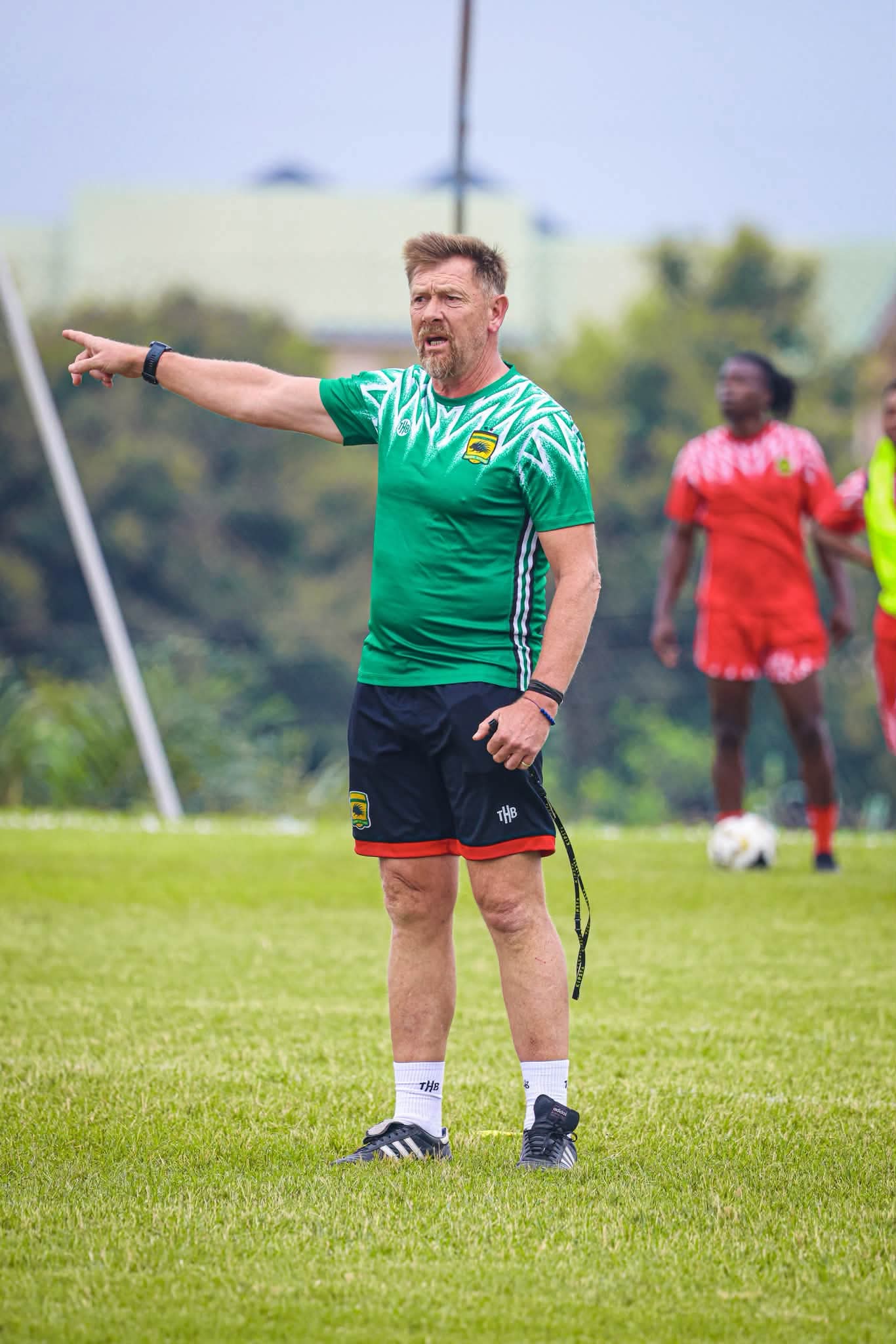
Asante Kotoko head coach Eric Tinkler says the club’s preseason has been shaped by a deliberate trade-off between physical conditioning and an accelerated recruitment drive, as the technical team worked to assess and strengthen the squad ahead of the new Ghana Premier League season.
Speaking on the club’s preparations, Tinkler explained that friendly fixtures were scheduled earlier than he would typically prefer in a preseason cycle, a decision driven by the need to evaluate the existing squad while simultaneously scouting for reinforcements.
We really have to overcross things, start certain friendly games a lot earlier than what I would normally do in the preseason, because we needed to assess players, to see the quality that we have, and then we needed to do a lot of scouting over the past three to four weeks,” Tinkler said.
The coach acknowledged that the scouting workload, conducted alongside assistant coach Stanley, had been demanding on the technical staff, as the pair reviewed footage of prospective signings both within Ghana and abroad.
A Foundation Under Pressure
Tinkler said the compressed timeline had a knock-on effect on the club’s physical preparation, which he considers a six-week process central to embedding the team’s playing model before competitive action begins.
It’s been hard work for the players. We’ve gone into certain friendlies where physically the players were extremely tired and exhausted.” Eric Tinkler, Head Coach, Asante Kotoko
He noted that the early fixtures reflected that fatigue, with performances improving only gradually as conditioning caught up with the demands of matches.
Mentally, too, the players were tested by the workload, though Tinkler pointed to a clear upward trend in subsequent outings.
In the beginning, we didn’t start very well in those friendlies, but progressively we’ve been getting better and better, and that’s what you want to see,”
he said, adding that the remaining six weeks before the league opener would be used to ensure the squad is physically and mentally ready, with recruitment also expected to be finalised in that window.
Squad Rebuild: Fewer Players, More Experience
Tinkler confirmed that supporters should expect significant changes to the playing squad, with a number of players released after the technical team and club leadership determined they did not fit the objectives set for this stage of Asante Kotoko’s history.
In their place, the club is bringing in a wave of new faces, including foreign-based players Tinkler described as arriving with considerable experience.
He added that further additions remain in the pipeline. “There’s one or two surprises still coming in terms of our signings,” he said, while declining to name the players involved.
Central to Tinkler’s approach is a deliberate reduction in squad numbers, from around 35 players last season to a target of 26 or 27.
He framed the smaller group as a means of fostering internal competition without sacrificing unity, describing a squad in which players contest positions directly while remaining aligned behind a common objective.
We want to try and have between 26, 27 players. Last season it was around about 35, but we want to make it a smaller squad, but a united squad,” Tinkler said. “A squad that are fighting position for position. There’s this competitiveness that we want to see in training, and then we take that competitiveness into our matches.”
Given the length of the football season, Tinkler stressed that early results would not be the measure of success. Instead, he pointed to consistency, in performance and in discipline both on and off the pitch, as the standard by which the campaign should be judged.
It’s not about winning your first game, your second game. You’ve got to be able to do that across the full season,” he said. “We want to ensure there’s consistency in terms of our performances, there’s consistency in terms of our discipline, both on and off the field.”